
Few Shot Learning: Unlock AI Power with Minimal Data
Explore how few shot learning enables powerful AI with minimal data, delivering automation and smarter decisions for your business.
Few-shot learning is a machine learning method that teaches an AI model new tasks using just a handful of examples. Instead of requiring thousands of data points like traditional AI, you simply show it a few samples. Think of it as teaching a new hire by walking them through a couple of examples, not by burying them in a manual. For businesses, this makes powerful AI from a platform like Mintline practical and efficient for very specific financial workflows.
From Data Mountains to a Handful of Examples

Imagine you’re training a new junior accountant to handle invoices. You wouldn't just dump 10,000 old invoices on their desk and expect them to figure it all out. Instead, you'd probably walk them through a few key examples: one from a major supplier, another for a monthly software subscription, and maybe a tricky one-off purchase. You'd point out the key information and patterns.
This simple, example-based teaching is exactly what few-shot learning brings to AI automation.
For years, building capable AI models meant one thing: data. An almost unimaginable amount of it. Businesses had to scale a mountain of information, spending a fortune on collecting and labelling it all just to teach an AI to do one thing well. This put powerful AI out of reach for most companies.
The Problem With Traditional AI
The old way of doing things creates a common headache for businesses, freelancers, and accounting firms. You have specific, unique tasks—like classifying receipts from local suppliers or matching transactions for a niche industry tool—but you don't have the massive datasets needed to train a standard AI model from the ground up.
This is where the inefficiency of traditional machine learning really shows. It's a powerful approach, but it just wasn't designed for the kind of nimble, specialised learning that modern work demands. This is one of the key areas where the role of AI in accounting is really starting to shine.
"The central promise of few-shot learning is efficiency. It shifts the focus from amassing huge datasets to leveraging prior knowledge, allowing AI to generalise from a small, curated set of examples."
A More Efficient Way Forward
Few-shot learning completely flips the script. It allows a tool like Mintline to automate complex tasks, such as receipt categorization and transaction matching, by learning from just a couple of your documents. Instead of needing thousands of your past receipts, the system can understand a new vendor's layout after seeing it just once or twice.
This method delivers serious efficiency gains. In some scenarios, it can lead to an 85% reduction in training time for AI models compared to older approaches. That's a game-changer for businesses that need to automate their financial close without a lengthy setup process.
This guide will walk you through how this technology works and how Mintline uses it to transform your financial workflows.
How Few-Shot Learning Actually Works
To really get a feel for how an AI can learn from just a handful of examples, let's stick with our junior accountant analogy. The magic of few-shot learning isn't about brute-force memorisation of thousands of documents. It’s about teaching a model how to learn and adapt to new information, fast.
The AI model doesn't start with a blank slate. It has already been pre-trained on a massive, diverse dataset, giving it a solid foundation in language, context, and general patterns. The few-shot process then takes this broad knowledge and sharpens it for a very specific job, like understanding your company's financial documents.
The Support Set and The Query
Think of it like a quick briefing before a new task. We hand the AI model two key pieces of information:
- The Support Set: This is a small, curated collection of labelled examples. In our accounting scenario, this might be just two or three invoices from 'Supplier A', all clearly marked. This set is the model's "cheat sheet" for the task.
- The Query: This is the new, unknown item we need the model to classify—for instance, an invoice that just landed in the inbox.
The AI’s task is to look at the query (the new invoice) and figure out if it belongs to the 'Supplier A' category by comparing it to the examples in the support set. It’s looking for tell-tale similarities in layout, keywords, and even numerical patterns to make its decision.
The crucial shift here is from rote memorisation to sophisticated pattern matching. The AI isn't just comparing pixels; it's learning the essence of what makes a 'Supplier A' invoice unique, even with very little to go on.
This whole process is incredibly efficient. The model doesn't need to be completely retrained every time you add a new supplier. It just applies its existing knowledge and adapts on the fly using the small support set you provide. This is exactly how platforms like Mintline can learn your company's specific document formats without needing months of configuration or huge archives of data. You can see how this works across different data types in our guide to structured data vs unstructured data.
From Learning Facts to Learning How to Learn
At its heart, few-shot learning is a form of meta-learning, or "learning to learn." The model is built not just to master one specific task, but to get really good at picking up new tasks quickly. It develops a generalised problem-solving skill it can deploy in unfamiliar situations.
This adaptability is a perfect match for dynamic business environments where things are always changing. A big part of making this work involves giving the AI clear instructions through well-designed prompts. For a closer look at improving AI accuracy with these methods, you can read about few-shot prompts and prompt engineering techniques. This helps the model focus on the most important features in your documents.
For a business using Mintline, this means the system gets smarter and more attuned to your operations with every document it processes. It’s an automation tool that genuinely adapts, staying accurate and relevant as your business grows and you start working with new partners.
Exploring the Different Few-Shot Learning Methods
The term few-shot learning isn't a single, monolithic technique. It’s more like a family of clever approaches designed to help AI learn with incredible efficiency. Think of it like knowing the difference between a hammer and a screwdriver; each is a tool built for a specific kind of problem. For businesses and finance professionals, understanding which method powers a tool like Mintline explains how it can adapt so quickly to your unique financial documents.
These methods generally fall into three main categories, each with its own logic for making sense of limited data. Some work by comparing new information to an 'average' example, while others focus on finding the best possible starting point for learning any new task.
This diagram shows the fundamental process that underpins all of these methods.
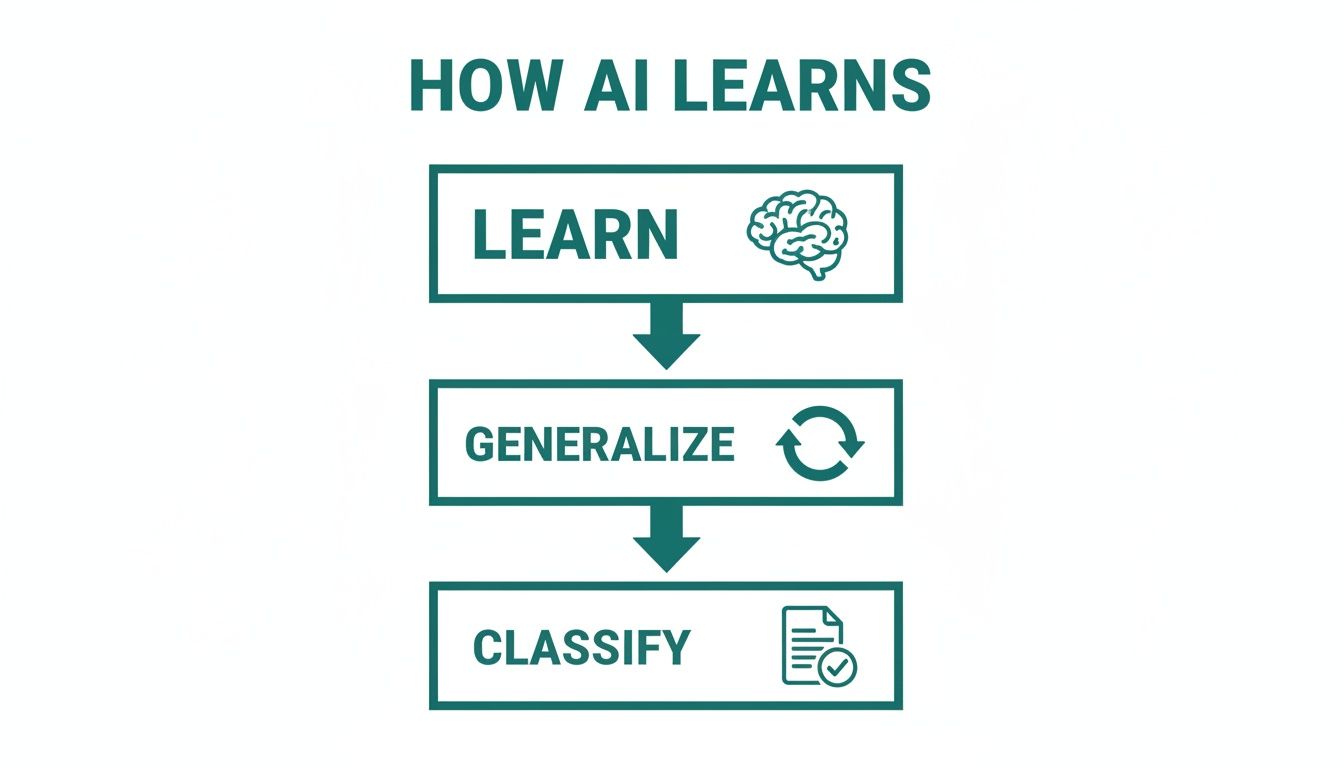
As you can see, the journey involves three core stages. The AI first learns from the data it’s given, then generalises patterns from that information, and finally uses those patterns to classify new, unseen data accurately.
1. Metric-Based Learning: Finding the Closest Match
One of the most intuitive approaches is metric-based learning. Imagine sorting mail. If you have a few labelled boxes for 'Invoices', 'Contracts', and 'Marketing', you’d pick up a new letter, glance at it, and decide which box it most closely resembles.
Metric-based methods do something very similar. They learn to measure the 'distance' or similarity between data points in a meaningful way. The AI essentially plots your examples in a conceptual space, and when a new item arrives—like a receipt from a new supplier—it simply checks which known category it's 'closest' to. It’s all about finding the nearest neighbour.
This works brilliantly for tasks like image recognition or document classification, where visual or semantic similarity is the key to getting it right. This is a core part of how Mintline quickly learns your document types.
2. Optimisation-Based Learning: A Better Starting Point
Another powerful category is optimisation-based learning, often called meta-learning. Instead of teaching a model to solve one specific task, this approach teaches the model how to learn new tasks more efficiently from the get-go.
It’s like training a new accountant. You could drill them on one company's specific invoice format until they've perfected it. Or, you could teach them general accounting principles that they can quickly apply to any company's invoices. Optimisation-based learning does the latter for AI.
The goal is to find a set of model parameters that serve as an excellent starting point. From this solid foundation, the model can adapt to a new task with just a handful of examples and minimal adjustments, making it incredibly versatile and quick to deploy.
3. Generative and Prompting Methods: Learning on the Fly
The third major group involves generative models and prompt-based learning. This approach has become hugely popular with the rise of large language models (LLMs). Here, the model learns to generate new data or follow instructions based on the few examples you provide directly in a prompt.
For instance, you might give a model two examples of a transaction summary and then ask it to create a new one for a different set of data. The model uses your examples as a template to understand the desired format and content, generating an output that matches the pattern.
Recent research highlights three main ways to do this, each with a trade-off between cost and performance: full fine-tuning (high accuracy, high cost), in-context learning (high efficiency, lower accuracy), and Low-Rank Adaptation (LoRA), which offers a great balance.
This is exactly how Mintline can understand and process a new type of financial document after seeing just a single example—it learns the pattern and applies it instantly.
To make these distinctions clearer, here’s a quick comparison of the main few-shot learning strategies.
Comparison of Few-Shot Learning Approaches
This table breaks down the three main approaches, outlining their core ideas, key advantages, and where they tend to shine.
| Approach | Core Idea | Pros | Cons | Best For |
|---|---|---|---|---|
| Metric-Based | Classify by measuring similarity to known examples ('prototypes'). | Simple to understand and implement. Works well for distinct categories. | Can struggle with subtle differences between classes. | Image classification, document sorting, spam filtering. |
| Optimisation-Based | Learn an optimal initial state that can be fine-tuned quickly for new tasks. | Highly adaptable and versatile. Excellent for diverse, changing tasks. | Can be more complex to implement and train initially. | Personalised recommendations, robotics, drug discovery. |
| Generative/Prompting | Use examples in-context to guide the model's output generation. | Extremely flexible and fast. No retraining needed for new tasks. | Performance is heavily dependent on prompt quality and model capability. | Text summarisation, data extraction, chatbot responses. |
Each of these methods has its place, and by employing a strategic mix of them, platforms like Mintline can deliver truly robust and adaptive automation. They turn a complex AI concept into a practical tool that can intelligently handle the unique and varied documents every business encounters.
The Algorithms That Make Smart Automation Possible
So, how does few-shot learning actually work its magic? It’s not about brute force; it’s about clever algorithms that allow an AI to learn efficiently from just a handful of your documents. Forget dense mathematics – the real genius is in the logic.
These algorithms are the core of what makes smart, adaptive automation platforms like Mintline so effective at automating your financial close.
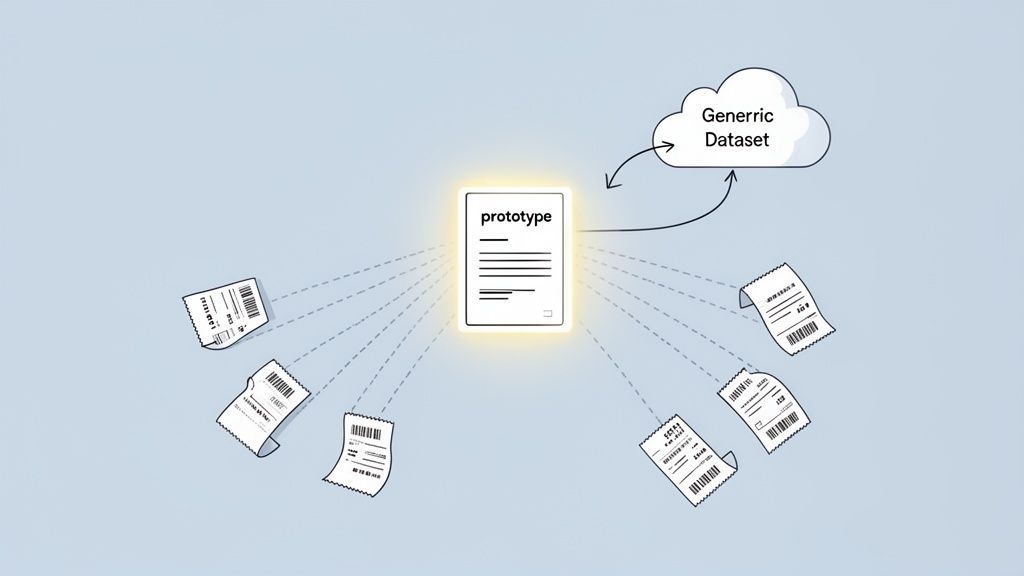
Let's look at two of the most important concepts: Prototypical Networks, which are brilliant for categorization, and Transfer Learning, which gives the AI a massive head start on any new task.
Prototypical Networks: Finding the 'Perfect' Example
Picture yourself sorting a stack of business receipts. You naturally group them into categories like 'Office Supplies', 'Travel', or 'Software'. For each category, you probably have a mental model of a typical example – a travel receipt has an airline logo and flight details, while a software receipt lists a monthly fee and user licences.
Prototypical Networks operate on a very similar principle. Instead of trying to memorize every single receipt it has ever seen, this metric-based learning algorithm analyses the few examples you provide for a category and creates a single, idealized 'prototype' for it.
This prototype isn't a copy of any one document; it's a mathematical average or central point of all the examples in that group. So, if you show Mintline a few invoices from a new vendor, it creates a prototype that captures that vendor's unique layout, logo placement, and common line items.
When a new, unknown document comes in, the system just compares it to each of its stored prototypes. It figures out which one the new document is "closest" to based on its features and confidently assigns it to that category.
The core idea is simple but incredibly powerful: classify new items by seeing which idealized example they most resemble. This makes sorting documents fast and efficient, even for vendors the system has only just met.
This method shines in tasks where clear patterns exist, like telling different types of financial documents apart. It’s why Mintline can instantly recognize a new supplier's invoice after you show it just one example.
Transfer Learning: Building on a Foundation of Knowledge
Another cornerstone of effective few-shot learning is transfer learning. This technique tackles a fundamental problem: how can an AI know anything about your specific documents without months of training? The answer is simple: it doesn't start from an empty slate.
Think of it as hiring a senior accountant versus a recent graduate. The senior accountant already has a deep well of knowledge about accounting principles, financial terms, and common document structures. When they join your company, they don't need to learn what an invoice is. They just need to learn your specific chart of accounts and supplier names.
Transfer learning gives an AI model that same head start. The model is first pre-trained on a massive, diverse dataset—often containing billions of documents, images, and text from across the internet. This initial training teaches it the fundamentals: language, context, and how to spot patterns in unstructured data.
This pre-trained model becomes the foundation. When Mintline applies it to a specialized task, like processing your company's unique expense reports, it transfers its vast general knowledge and applies it to your specific problem. It only needs a few of your examples to fine-tune its understanding for your precise needs.
This approach delivers two huge benefits:
- Speed: The model gets up to speed on your tasks in a fraction of the time because the foundational learning is already complete.
- Reduced Data Needs: Since the model is already an expert in general documents, it doesn't need to see thousands of your files to understand the context.
In essence, transfer learning provides the "general intelligence," while the few examples you provide add the specific "local knowledge." This powerful combination is what allows a tool like Mintline to deliver accurate, specialized automation that feels like it was built just for your business from day one.
Putting Few-Shot Learning to Work in the Real World
This technology isn't just an academic concept; it's the engine driving modern business automation right now. The ideas behind few-shot learning are what allow AI tools like Mintline to tackle your unique financial challenges without needing a mountain of custom-built data. This adaptability is paving the way for practical, powerful applications across all sorts of industries.
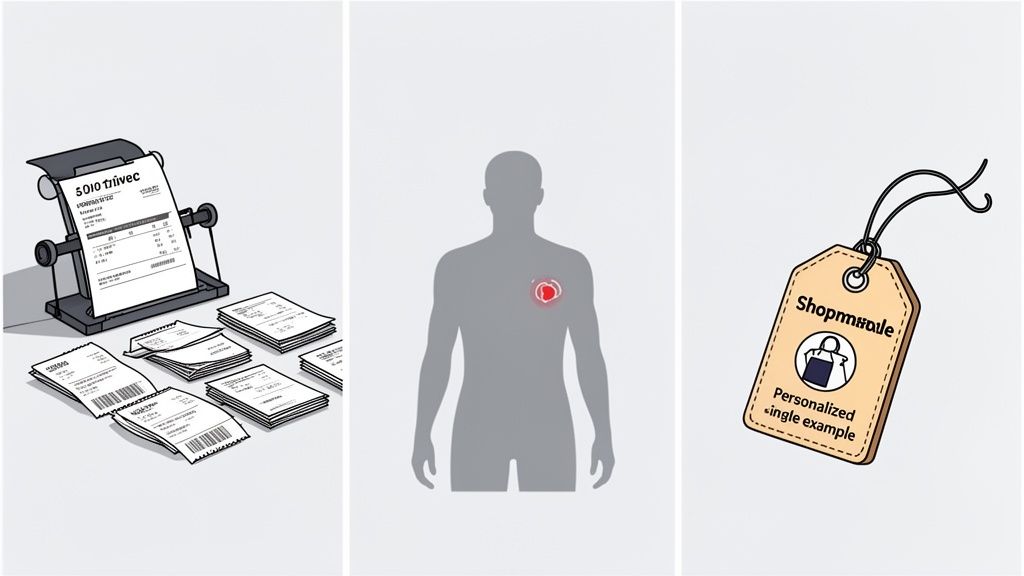
For anyone in finance or operations, one of the most immediate and tangible applications is in document automation. It's the engine driving the next wave of intelligent financial software.
A New Era for Document Processing
Think about what happens when you start working with a new supplier. In the past, this usually meant manually creating new rules in your accounting software or spending time keying in data from their specific invoice layout month after month. Few-shot learning completely sidesteps this tedious setup.
With a platform like Mintline, the system can learn a new invoice format from the very first document you process. By looking at just one example, it can figure out where to find key fields—like the vendor's name, invoice number, and total amount—and then apply that logic to every future invoice from that supplier. That’s the core benefit right there: getting powerful, customized automation from surprisingly little data. For a deeper look into this area, you can explore our complete guide on intelligent document processing.
This same principle is making waves in other sectors, too. Marketers, for instance, are finding it easier to use advanced Generative AI tools for marketing because the tech can adapt to a specific brand voice or campaign goal with just a few examples, reducing the data burden significantly.
Applications Beyond Finance
While the impact on financial workflows is clear, the versatility of few-shot learning reaches far beyond invoices and receipts. Its ability to draw broad conclusions from limited information is solving critical problems in highly specialized fields.
-
Medical Imaging: Radiologists can train an AI to identify a rare disease in medical scans. Instead of needing thousands of images of an uncommon condition, a model can learn to spot the crucial markers from just a handful of confirmed cases.
-
E-commerce Personalization: An online shop can offer tailored recommendations based on what a user is doing right now. By analyzing the last few items a shopper clicked on, the system can infer their current interest and suggest relevant products without needing their entire purchase history.
The healthcare industry, in particular, has seen huge benefits. Drug discovery is one of the most impactful examples, where the technology helps speed up the identification of potential drug candidates by learning from a small set of known chemical compounds. This is completely changing how healthcare organizations approach AI, especially in specialities where collecting thousands of examples of a rare condition is simply not possible. For the finance teams inside these organizations, needing less data directly translates to lower costs and faster rollouts of AI-assisted systems for things like billing and expense management. Discover more insights about these applications on research.aimultiple.com.
The common thread across all these examples is efficiency. Few-shot learning allows systems to become specialists quickly, turning them from generic tools into experts finely tuned to a specific task, whether that's understanding a new invoice or identifying a rare medical condition.
The Future: Making AI More Accessible and Efficient
At its core, few-shot learning represents a massive change in how we think about artificial intelligence. For a long time, powerful AI was the exclusive playground of big tech companies with the money and resources to collect enormous datasets. Few-shot learning helps to level that playing field.
It’s about shifting AI from a brute-force tool that needs endless data to a smarter, more nimble technology. This is precisely what allows a platform like Mintline to offer automation that genuinely understands your specific business. It can learn your unique vendor invoices or transaction categories without you needing a data science team or feeding it thousands of old documents.
The future is one where smart tools are far more adaptable and don't require so much heavy lifting from us to get the job done.
Advanced AI Is No Longer Out of Reach
If you take one thing away from this, let it be this: sophisticated AI isn't some far-off dream reserved for massive corporations anymore. It's here, and it's ready to tackle the tedious, time-sucking problems that plague freelancers, small businesses, and finance teams every single day.
By learning from just a handful of examples, this technology tears down the single biggest barrier to entry—the need for massive datasets. It makes powerful automation a practical reality for any organization, no matter its size.
This shift means you can get back to focusing on what actually matters—growing your business—instead of drowning in administrative quicksand like chasing down receipts or manually matching transactions. Mintline is built on this very idea, turning a deeply complex AI capability into a simple, effective tool that just works.
A Smarter Way to Work
Few-shot learning is the engine behind a new generation of software that acts more like a sharp human assistant. It learns fast, adapts to new information on the fly, and gets better at its job with just a little bit of guidance.
This isn't just about saving a few hours here and there; it's about building more resilient and efficient operations from the ground up. The technology is ready to help you close your books faster, slash costly human errors, and keep every financial document perfectly organized. It’s not a small improvement—it’s a new, more accessible way of working, powered by genuinely intelligent automation.
Frequently Asked Questions About Few-Shot Learning
As few-shot learning becomes a bigger part of business automation, questions naturally pop up. We’ve collected some of the most common ones we hear from founders and finance pros to give you clear, straightforward answers.
What’s the Difference Between Few-Shot, One-Shot, and Zero-Shot Learning?
Think of these terms as a scale measuring how many examples an AI needs to learn something new. The key difference is simply the number of samples you give it.
- Few-Shot Learning: This is the middle ground. You give the model a small handful of examples, usually two to five, to pick up a pattern. It’s the sweet spot for many business tools.
- One-Shot Learning: Here, the model gets exactly one example. This is incredibly useful for tasks like teaching a system a new invoice format after seeing it just once.
- Zero-Shot Learning: This is the most advanced approach. The model gets zero direct examples and has to figure things out based on a description and its existing knowledge.
Most practical tools today, including Mintline, use a smart blend of few-shot and one-shot techniques. This mix strikes the perfect balance between high accuracy and real-world efficiency for financial tasks.
Is Few-Shot Learning Less Accurate Than Traditional Machine Learning?
Not really—it's more about using the right tool for the job. A traditional model trained on a massive dataset can be incredibly accurate for a broad, general task. But few-shot learning shines where those massive datasets just don't exist: specialised, niche tasks. Its accuracy comes from being great at generalising from small clues, not just memorising piles of data.
For custom business needs—like classifying your company's unique vendor invoices or matching specific transaction types—few-shot learning is often far more practical and can achieve very high accuracy much faster. It's built for precision in your world.
Do I Need to Be a Data Scientist to Use Tools with Few-Shot Learning?
Absolutely not. That’s the whole point. The real magic of few-shot learning is that it powers easy-to-use applications that hide all the complexity. Platforms like Mintline are designed from the ground up for business professionals, founders, and finance teams—not AI experts.
The technology does all the heavy lifting behind the scenes. You get to "teach" the software new tricks just by showing it an example or two of a document or transaction. It’s all the power of advanced AI, with none of the technical headaches.
How Much Data Do I Actually Need for Few-Shot Learning?
When we say "few," we mean it. While the exact number depends on how tricky the task is, you often only need as little as one to five examples for each new category.
For instance, to get an AI to recognise invoices from a new supplier you just started working with, you might only need to show it one or two. This is a world away from the thousands of examples older AI models needed, making it a perfect fit for businesses that need to adapt on the fly without huge data archives.
Ready to stop chasing receipts and automate your financial close? Mintline uses few-shot learning to link every bank transaction to its corresponding document automatically, turning hours of monthly admin into minutes. Get started for free and see how it works.