
Your Guide to a Thriving Frontend Developer Freelance Career
Launch your frontend developer freelance career with this guide on skills, portfolios, client acquisition, and pricing strategies in the Dutch market.
So, you're ready to jump into the world of freelance frontend development. It's a fantastic move, but being a great coder is only half the battle. To truly succeed as a frontend developer freelance professional, you have to start thinking like a business owner. This guide is your roadmap to making that happen, especially if you're navigating the bustling Dutch tech scene.
Launching Your Freelance Frontend Career
Making the leap from a salaried role to freelancing is a huge step. Suddenly, you're not just responsible for building slick user interfaces; you're also the sales team, the project manager, and the finance department all rolled into one. It’s a major mental shift.
Many brilliant developers get bogged down by the admin side of things. They can craft pixel-perfect designs in their sleep but stumble when it comes to invoicing, chasing payments, or marketing themselves effectively.
More Than Just Code
To really make a go of it, you need to add a few more tools to your belt beyond your favourite IDE. Think of it as expanding your personal tech stack. You'll need to get good at:
- Selling Yourself: This isn't about being pushy. It's about building a brand and a portfolio that speaks directly to the clients you want to work with.
- Talking Money: You have to get comfortable pricing your services. That means knowing the market rates and, more importantly, clearly explaining the value you bring to a project.
- Managing People: Client relationships are everything. Clear communication and setting expectations from the start will save you countless headaches and lead to glowing referrals.
- Sorting Your Finances: This is the big one. You need a system for invoicing, tracking every single expense, and staying on top of your taxes. Letting this slide is a fast track to financial chaos.
Your success as a freelancer will ultimately come down to your business savvy, not just your coding skills. Getting that business mindset right from day one is the key to building something that lasts.
This guide will walk you through the practical stuff—from crafting a portfolio that actually gets you hired to setting rates that reflect your expertise. We’ll also look at tools that can take the pain out of the admin. For example, check out how Mintline’s pricing is designed to help freelancers automate their bookkeeping. It frees you up to do what you actually love: building incredible web experiences and growing your client base.
1. Build Your Freelance Tech Stack
Your success as a freelance frontend developer hinges on the skills you bring to the table. This isn't just about padding your CV with buzzwords; it's about making smart choices that attract the clients you want and allow you to charge what you're worth. A well-curated tech stack is your proof that you can deliver modern, efficient, and reliable solutions.
Think of it this way: clients aren’t just hiring a "React developer." They're hiring someone to build a lightning-fast e-commerce site that actually converts visitors into customers. Your job is to show them you have the exact tools and expertise for their problem.
It all starts with getting the basics right.
Nail the Core Fundamentals
Before you even think about the latest, shiniest framework, your command of the web's foundational trio needs to be absolute. These are the non-negotiables, and any serious client will expect you to know them inside and out.
-
HTML: This is the skeleton of every website. As a freelancer, you need a deep understanding of semantic HTML5. Why? Because it’s crucial for accessibility and SEO—two massive selling points for any business.
-
CSS: The visual magic happens here. You have to go way beyond changing colours and fonts. Mastery of modern layout techniques like Flexbox and Grid, along with a bulletproof approach to responsive design, is what clients pay for. They need sites that look perfect everywhere.
-
JavaScript (ES6+): This is what brings a site to life. You absolutely must be comfortable with modern JavaScript (ES6 and newer). Features like modules, promises, and async/await aren't just 'nice-to-haves'; they're standard practice in every professional project today.
Without a rock-solid grip on these three, everything else you build will be on shaky ground.
Choose Your Frameworks Wisely
In the Dutch freelance market, a few JavaScript frameworks really dominate the scene. It’s far better to become an expert in one or two of these than to be a jack-of-all-trades, master of none.
Right now, React is the clear frontrunner for freelance gigs. Its component-based structure and enormous ecosystem make it the top choice for everyone from brand-new startups to established corporations.
That said, Vue.js has a very strong and loyal following, particularly praised for its gentle learning curve and fantastic documentation. You’ll find plenty of Dutch scale-ups and creative agencies that prefer Vue, making it a seriously valuable skill to have. While other options are out there, focusing on mastering React or Vue will open the most doors to high-quality projects.
A classic rookie mistake is jumping on every new framework that comes out. Don't. Go deep on one. True mastery of React, for instance, is infinitely more valuable to a client than a superficial understanding of five different technologies.
The Skills That Set You Apart
Being a professional isn't just about the code you write. It's about how you work. Certain skills signal to clients that you're a seasoned expert who understands the entire project lifecycle, not just a small piece of it. These are the abilities that separate the amateurs from the pros who command top rates.
Here’s a look at the technologies and practices that truly define a professional freelance developer.
Essential Frontend Freelancer Tech Stack
| Category | Core Technologies | Why It Matters for Freelancers |
|---|---|---|
| Version Control | Git, GitHub/GitLab | This is non-negotiable for collaboration and managing code professionally. Not knowing Git is a huge red flag for any serious client. |
| Build Tools & Performance | Vite, Webpack | Shows you understand modern workflows and can build fast, optimised apps. Speed directly impacts user experience and a client's bottom line. |
| Testing | Jest, Vitest, Cypress | Writing tests proves you’re committed to quality and building stable, bug-free software. This saves the client money on long-term maintenance. |
| Accessibility (a11y) | WCAG Standards, ARIA | With laws like the European Accessibility Act, being able to build inclusive websites is no longer a niche skill—it's a massive competitive advantage. |
When you can confidently talk about these skills, you're not just selling code. You're showing a potential client that you are a reliable partner who can be trusted to build scalable, high-quality digital products. And that's exactly what they're willing to pay a premium for.
Creating a Portfolio That Converts Prospects into Clients
Your portfolio is your single most important sales tool as a freelancer. Let's be clear: it’s not just a gallery of past work. It's a strategic asset designed to tell a story. A powerful portfolio doesn’t just show what you built—it explains why you built it and what business problem it solved.
Potential clients aren't just looking for someone who can write clean React components. They're searching for a partner who can grasp their vision and turn it into a tangible product that actually delivers results. Your portfolio is your proof that you are that partner.
This shift in perspective is what separates the struggling freelancers from the successful ones. Stop thinking like a developer just showing off code and start thinking like a consultant presenting solutions.
Select Your Projects Strategically
Quality always, always trumps quantity. I'd much rather see a portfolio with three knockout case studies than one with ten links to simple projects. Your job is to curate a selection that showcases the breadth and depth of what you can do.
Don't have a lot of commercial experience yet? No problem. You can absolutely build a compelling collection from scratch.
- Personal Projects: Go build something cool. Find a problem you're passionate about and create a complete, polished application to solve it. Just make sure you document the entire process as if it were for a real client.
- Pro Bono Work: A fantastic way to get your foot in the door is to offer your skills to a local charity or non-profit. This gives you genuine, real-world experience and a meaningful project to add to your collection.
- Conceptual Redesigns: Find a well-known website with obvious user experience issues and give its frontend a complete overhaul. The key here is to explain your reasoning and demonstrate the improvements with before-and-after mockups or, even better, a live demo.
Treat every project—paid or not—like a professional engagement. A top-tier portfolio is your best marketing tool. If you need a more detailed walkthrough, learning how to build a portfolio website that really sells your skills is a great place to start.
Your portfolio should be a curated highlight reel, not a dusty archive of everything you've ever built. Each project must serve a purpose, demonstrating a specific skill or your problem-solving muscle.
By being selective, you guide a potential client's attention straight to the work that best represents your value and aligns with the kinds of projects you actually want to land.
Transform Projects into Powerful Case Studies
Just dropping a screenshot and a link on a page isn't going to cut it. If you want to turn a prospect into a paying client, you need to walk them through your process and clearly show the value you brought to the table. The best way to do this is by structuring each project as a mini case study.
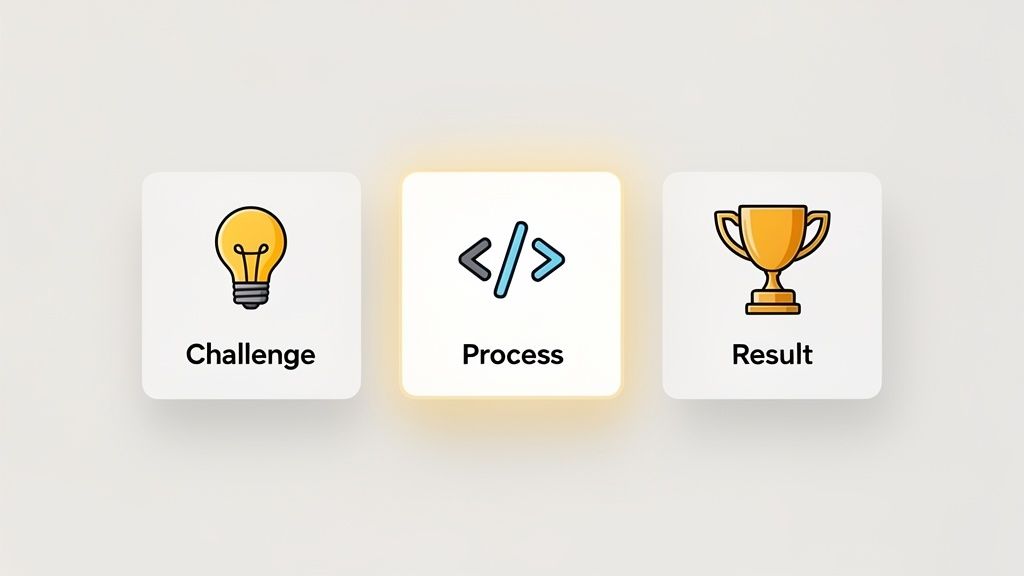
Think of it as a simple story: Challenge, Process, Result.
- The Challenge: Kick things off by clearly defining the problem. What was the client trying to achieve? Were they looking to increase user engagement, boost conversion rates, or modernise a clunky, dated interface? This context is everything.
- Your Process: This is where you get to shine. Detail the steps you took to crack the code. Mention the specific technologies you used (e.g., "We migrated the site from a legacy jQuery codebase to a modern Nuxt 3 application") but, more importantly, explain why you chose them. Talk about any tricky challenges you overcame, like performance bottlenecks or accessibility hurdles.
- The Result: You have to end with the impact. Whenever you can, use hard numbers and concrete metrics. Did your work lead to a 25% increase in mobile conversions? Did you improve the Lighthouse performance score from 60 to 95? Tangible results are undeniable proof of your value.
This structure transforms a boring project description into a persuasive argument for hiring you. It shows you're not just a coder for hire; you're a strategic thinker who delivers measurable outcomes.
Polish Your Presentation
The final piece of the puzzle is the package itself. Remember, your portfolio website is a living, breathing demonstration of your skills as a freelance frontend developer. It has to be flawless.
Sweat the details that scream professionalism:
- Clean and Modern Design: Your site needs to look the part. It should be visually appealing, intuitive to navigate, and, of course, fully responsive.
- Exceptional Performance: Nothing kills credibility faster than a slow-loading portfolio. Optimise your images, minify your code, and make sure your site is lightning-fast.
- Perfect User Experience (UX): The journey through your portfolio should be effortless. Make it dead simple for potential clients to find your best work, understand your process, and get in touch.
Your portfolio is often the very first impression a client will have of you. By thoughtfully curating your projects, framing them as compelling stories, and presenting them in a polished, professional package, you'll build a powerful engine for winning high-quality freelance work.
Setting Your Rates and Crafting Winning Proposals
Figuring out what to charge is probably the biggest headache for any new freelance frontend developer. It's a tricky balancing act. If you price yourself too low, you're not just selling yourself short; you're making it impossible to build a real business. Go too high without the portfolio to back it up, and you might just scare everyone away. The trick is to stop guessing and start thinking strategically.
Your rate isn't just about your time spent coding. It has to cover all the less glamorous stuff: your business software, taxes, pension contributions, and those weeks you plan to take off for a holiday. And most importantly, it needs a profit margin so you can actually grow.
Choosing Your Pricing Model
There’s no single “right” way to price your services. The best model really depends on the project and what the client is comfortable with. Most freelancers I know stick to one of these three main approaches.
-
Hourly Rate: This is the simplest to understand and a great place to start. Clients get it, and it protects you from "scope creep"—that dreaded moment they ask for "just one more little thing." The only real downside? It can feel like you're being penalised for being fast and efficient.
-
Daily or Weekly Rate: For longer projects, this is a lifesaver. It makes billing so much simpler and gives both you and the client a clear budget for a set period. It's a standard, respected practice, especially if you're contracting with a larger company's team.
-
Project-Based Fee: Here, you're charging for the result, not the hours. This is where you can really earn based on the value you deliver, which often works out to be much more profitable. The risk, of course, is underestimating the work. If you get it wrong, your effective hourly rate can take a nosedive. This model absolutely requires a rock-solid, detailed project scope before you write a single line of code.
Your pricing model is a strategic choice. For a well-defined, short-term task, a project fee might be best. For a long-term collaboration with an evolving scope, a daily rate often makes the most sense.
Knowing the local market is also hugely important. Here in the Netherlands, the tech scene is absolutely buzzing, and good freelancers are in high demand. The latest data shows that the average contract compensation for a freelance developer can hit €141,000 a year. That number is largely down to a major talent shortage, with companies all competing for skilled people like you.
Crafting Proposals That Win Business
A good proposal is much more than a price tag. It's your first real chance to show a potential client that you don't just hear their request—you understand their problem. It needs to be professional, persuasive, and leave zero room for confusion.
Make sure every proposal you send nails these key points:
- Project Understanding: First, play back the client's goals in your own words. This immediately shows you were listening and that you're focused on the business outcome, not just the technical task.
- Detailed Scope of Work: Be specific. Break down exactly what you'll deliver. List the pages, features, and functions included in the price. The more precise you are here, the fewer headaches you'll have down the line.
- Deliverables and Timeline: Give them a clear roadmap with key milestones. What will they get, and when will they get it? This sets clear expectations from the get-go.
- Pricing and Payment Terms: State the total cost and how you expect to be paid. A 50% upfront and 50% on completion schedule is a common and fair way to structure it.
This document is the foundation of your entire working relationship. To make sure you’re paid what you're worth, you need to set good rates and also learn how to negotiate freelance rates effectively.
Ultimately, a proposal is all about building trust. It’s your opportunity to prove you’re not just a coder for hire, but a professional partner who’s invested in their success. It’s the document that leads to a formal contract, protecting both of you by making sure everyone is on the same page. When you're ready to bill against that proposal, you can explore our guide on pro forma invoices to get the payment process started the right way.
How to Find High-Quality Freelance Clients
A beautiful portfolio and a solid pricing model are great, but they won't pay the bills without a steady flow of clients. The real trick to finding high-quality work as a freelance frontend developer isn't about spamming every job board out there. It’s about building a solid pipeline of projects where your expertise is genuinely valued.
Forget the race-to-the-bottom mentality you see on so many platforms. To really succeed, you need to shift your mindset from simply being a skilled coder to becoming a visible, trusted expert in the Dutch tech community. When you build that kind of reputation, the dynamic flips—clients start seeking you out, and you can finally break free from that nerve-wracking feast-or-famine cycle.
Go Beyond the Freelance Platforms
Sure, platforms like Upwork or Malt can be decent for landing your first gig or two, but they often turn into a relentless grind where everyone is competing on price. Let’s be honest: the most rewarding and lucrative projects are rarely found there. If you want to build a long-term, sustainable career, you've got to think bigger and focus on building real relationships.
Your personal and professional networks are, without a doubt, your most powerful tools.
- Tap into Your Personal Network: You’d be surprised how many leads can come from your existing connections. Make sure friends, family, and former colleagues know you’re freelancing. The tech world in the Netherlands is surprisingly small, and a warm referral from someone they trust is worth a hundred cold applications.
- Show Up at Local Tech Meetups: The Netherlands has a buzzing tech scene. You can find meetups for just about anything, from JavaScript deep dives to specific framework user groups. Don't just be a wallflower—get involved, ask smart questions, and talk about what you're passionate about. These events are goldmines for making genuine connections with potential clients and future collaborators.
Master Your Professional Presence on LinkedIn
LinkedIn is so much more than an online CV; it's a lead-generation machine if you use it right. A properly optimised profile will pull in recruiters and hiring managers looking for exactly your kind of freelance frontend expertise.
Start by treating your profile like a landing page for your one-person business. Get a professional headshot, write a punchy headline that says exactly what you do (e.g., "Freelance React Developer Specialising in E-commerce Performance"), and use that "About" section to tell a compelling story about the specific problems you solve.
Think of every connection on LinkedIn as a potential door to a new opportunity. Engage with content, share your insights on frontend development, and build relationships—don't just collect contacts.
This image gives you a quick look at some key financial metrics for freelancers here in the Dutch market.
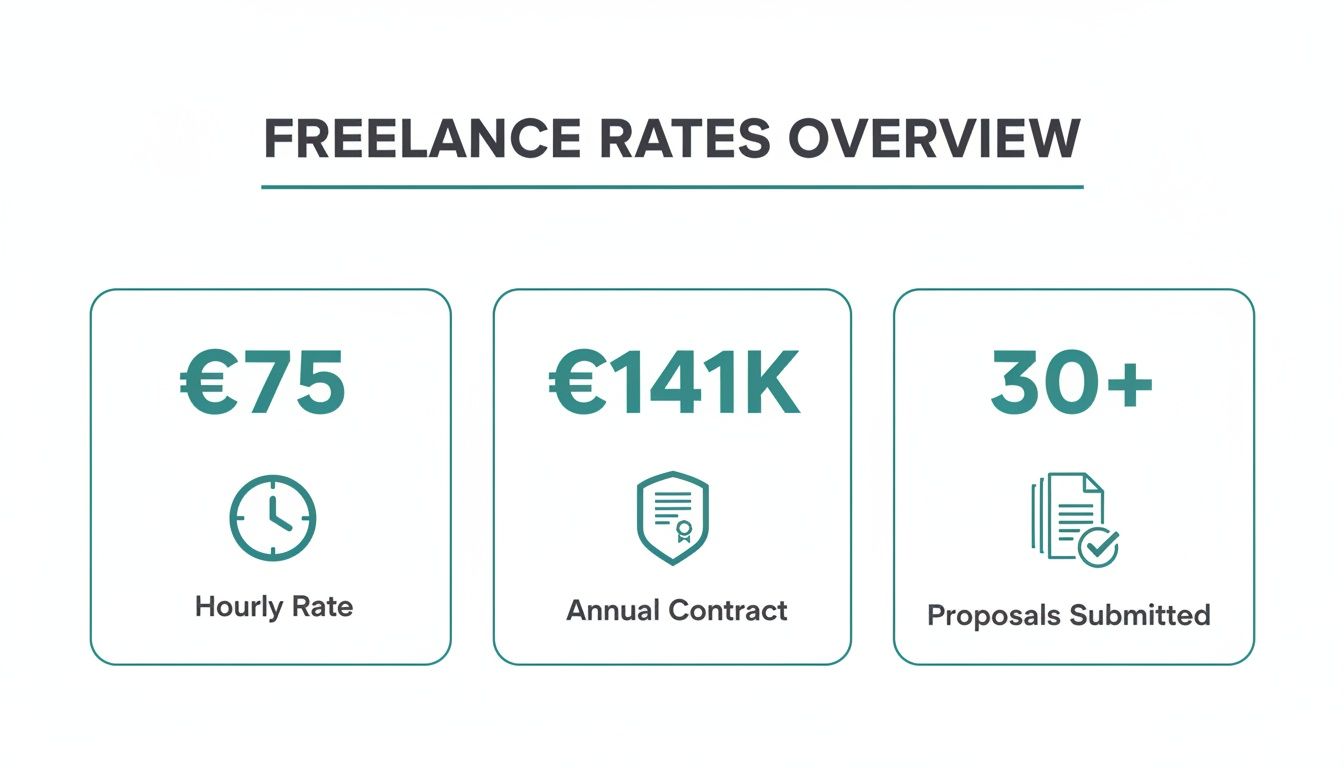
The numbers definitely highlight the high earning potential, but they also hammer home how important it is to secure consistent, well-paying contracts to hit those kinds of annual figures.
Write Pitches That Actually Get Read
When you do find yourself sending a cold pitch or applying for a posted gig, personalisation is everything. We all know what a generic, copy-pasted message looks like, and it goes straight to the bin. Your entire goal is to show you’ve done your homework and you actually understand what the client is trying to achieve.
A pitch that wins is one that:
- Addresses a Specific Person: Do a little digging to find the name of the hiring manager or project lead.
- References Their Project or Company: Prove you've actually looked at their website or product. Mention something specific you liked or an area you see for improvement.
- Connects Your Skills to Their Needs: Don't just rattle off your tech stack. Explain how your experience with Next.js, for instance, will directly help them achieve their goal of a faster, more SEO-friendly site.
It’s also incredibly important to know the market you’re operating in. For example, the Dutch frontend freelance scene has a noticeable gender pay gap of 13% that favours men. Even with an average compensation around €141,000, the data shows that men often expect—and receive—higher offers, which creates an unfair imbalance. Knowing this is powerful. It empowers all freelancers, especially women, to push for equitable pay and use hard data to negotiate better contracts. You can dig deeper into the rising developer salaries in the Netherlands and the gender dynamics at play.
Getting Your Freelance Finances on Autopilot with Mintline
As a freelance frontend developer, you want to spend your time building incredible web experiences, not getting lost in spreadsheets and chasing down old receipts. But when you're running your own show, you're also the finance department. Let's be honest, financial admin is a crucial part of the job, but it's often the part developers enjoy the least.
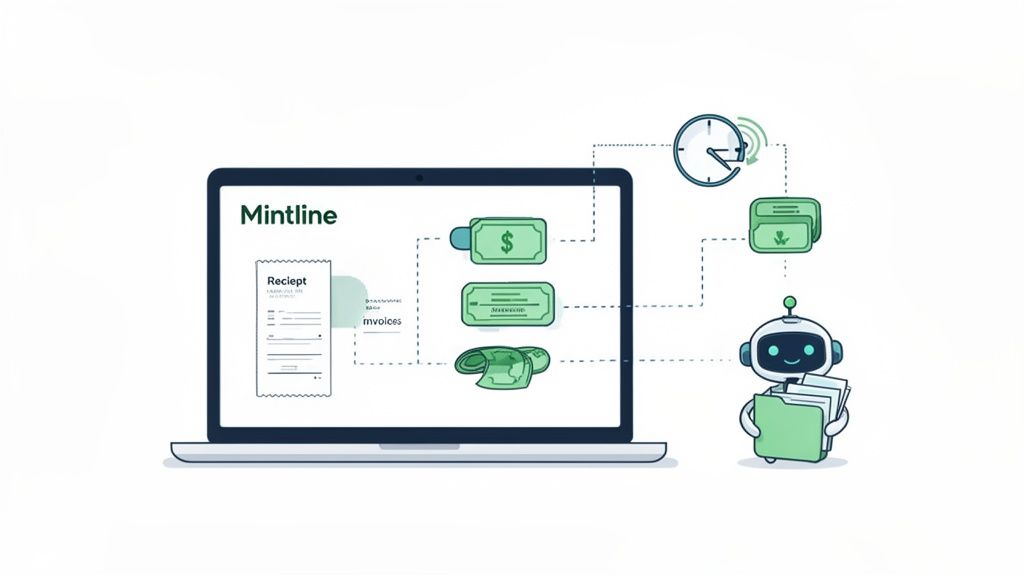
This is where you bring in some smart automation to do the heavy lifting. Instead of burning hours manually matching bank transactions to invoices or digging through emails for a receipt from three months ago, you can use tools built specifically to handle the grind for you.
From Manual Mess to Automated Magic
Think about it: a system where every transaction from your business account is automatically paired with the right invoice or receipt. No more tedious data entry. No more crossed wires. That’s exactly what a platform like Mintline is designed to do. It uses AI to intelligently sync up your financial data, transforming a boring, error-prone chore into a smooth, automated process.
For instance, when you pay for a new software subscription or your coworking space, the system flags the transaction and links it to the digital receipt you've uploaded. This creates a crystal-clear, auditable trail for every euro spent—something that’s absolutely essential for accurate bookkeeping and tax returns here in the Netherlands. You can even use a slick document scanner online to digitise paper receipts the moment you get them.
Your Financial Health, in Real Time
One of the toughest parts of being a frontend developer freelance professional is knowing exactly where you stand financially at any given moment. Are you actually profitable this month? How much BTW (VAT) do you need to put aside? Relying on an end-of-month spreadsheet update only gives you a look in the rearview mirror.
Modern finance tools give you a live dashboard for your business.
- Live Financials: Instantly see your income, expenses, and profit margin.
- Missing Document Alerts: The system will tell you straight away if a transaction is missing its corresponding paperwork.
- Smart Categorisation: Expenses are automatically sorted into the right business categories, making tax deductions a breeze.
Automating your books isn't just about saving time. It's about gaining the financial clarity to make better decisions for your business, whether that’s adjusting your rates or investing in new gear.
Tax Time Without the Panic Attack
When the tax deadline looms, this is where automation really shines. Forget the frantic scramble to pull together a year's worth of documents. With everything matched and categorised as you go, you can generate tax-ready reports with a couple of clicks. The hard work is already done.
This means you can hand over clean, perfectly organised data to your accountant or confidently file your own returns. Hours of admin-fuelled stress simply disappear, freeing you up to focus on what you’re actually good at: coding and building your freelance career.
Got Questions? Here Are Some Real-World Answers
Diving into the freelance world is exciting, but let's be honest—it also brings up a ton of questions, especially about the business side of things. If you’re just starting out as a frontend developer in the Netherlands, you're not alone in wondering about these things.
What Can I Realistically Earn as a Freelancer in the Netherlands?
This is the big one, isn't it? The good news is, the potential is huge. We've seen data showing that average contract compensation can hit €141,000 a year, which just shows how strong the demand is.
When you're starting, a rate somewhere between €50-€70 per hour is a solid target. Once you've got a few projects under your belt and can really show off your expertise in popular frameworks like React or Vue, you can comfortably push that to €80-€120 per hour, sometimes even more. It's all about the value you bring to the table, not just the lines of code you write.
How Much of My Income Should I Stash Away for Taxes?
Okay, this is crucial. As a freelancer (or ZZP'er) in the Netherlands, you’re in charge of your own income tax and BTW (VAT). A rock-solid rule of thumb is to put aside 25-30% of every single payment you receive.
This isn't just a suggestion; it's the key to avoiding a massive headache later. This buffer covers your income tax and makes sure you have the BTW ready to hand over to the Belastingdienst (the Dutch Tax and Customs Administration) when your quarterly deadline rolls around. Trust me, you don't want to be scrambling for that money.
My best piece of advice? The moment an invoice is paid, transfer that tax percentage into a separate savings account. Don't even look at it. This simple habit is probably the most important financial discipline you can build as a freelancer.
Should I Charge by the Hour or a Flat Project Fee?
Ah, the classic debate. There’s no magic answer here because it really depends on the gig.
Here’s how I think about it:
- Go hourly for projects where the scope is a bit fuzzy or for any kind of ongoing maintenance. It’s your safety net against "scope creep"—that dreaded moment when a small task balloons into something huge. This way, you're paid for all your time.
- Go with a project fee when the deliverables are crystal clear. If you can confidently map out the work from start to finish, this model is fantastic. It lets you price based on value, and if you're efficient, your effective hourly rate can end up being much higher.
A lot of seasoned freelancers I know, myself included, often start with an hourly rate for a new client. It builds trust. Once you have a good working relationship, you can switch to project-based fees for future work.
Remember, the code you write is only half the battle. Nailing the business side is what turns a good developer into a successful freelancer. Tools like Mintline can be a lifesaver here, taking care of the tedious financial admin like matching receipts and getting you ready for tax time. It leaves you free to focus on what you actually enjoy doing. See how Mintline can make your freelance finances easier.