
Pro Forma Invoice Mean: A Clear Guide for Businesses
Unclear what pro forma invoice mean? This guide explains its purpose, legal status, and how Dutch freelancers and SMBs can use it for clear transactions.
Think of a pro forma invoice as a detailed agreement before the real deal happens. It’s a document you send a buyer before you ship the goods or start the work. It’s like getting a detailed summary of your online shopping basket, confirming everything you've agreed on before you actually click 'buy'. It lists out all the items, quantities, and prices so everyone is on the same page.
What Does a Pro Forma Invoice Mean in Practice?
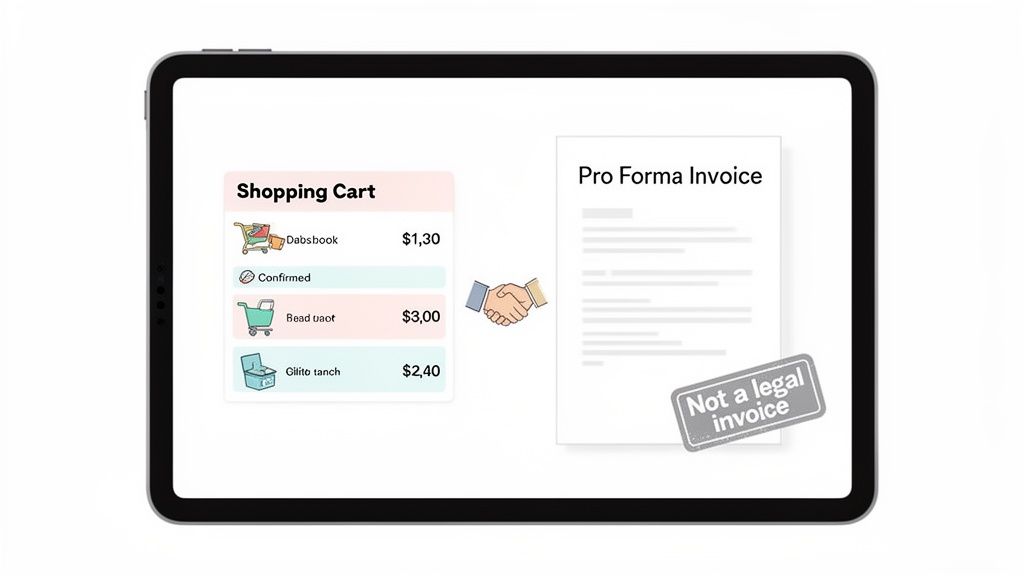
Let's say you're about to place a large order with a new supplier. Before you wire over the money, you need to be crystal clear on every single detail. That’s where the pro forma invoice comes in. It acts as a gesture of good faith, putting the agreed-upon terms on paper before the transaction becomes official.
This preliminary bill gives a transparent, itemised breakdown of the sale. It feels more concrete than a quote but doesn't cross the line into a legal demand for payment. Its main job is to set expectations straight from the start.
Setting Expectations Without Legal Obligations
The single most important thing to grasp about a pro forma invoice is its legal standing. It carries no fiscal value. It isn't a tax invoice, and you can't use it for your official bookkeeping or VAT records. It's purely a communication tool, not a financial one.
A pro forma invoice is essentially a formal promise. It tells your customer, "This is exactly what we've agreed on for our transaction." It provides total clarity and helps avoid any nasty surprises later.
Because it isn't legally binding, it gives you a bit of wiggle room. If something needs to change—maybe the customer wants to adjust the quantity or you need to tweak the shipping plan—you can simply amend the pro forma. No need for complicated credit notes or cancellations.
Only when everything is finalised and the goods are on their way do you issue the final, official commercial invoice. That's the document that counts for your accounts and becomes a legal record.
The Role in Business Workflows
So, if it’s not a "real" invoice, why bother? Its practical value is huge for keeping operations running smoothly. In international trade, for instance, it's often used to declare the value of goods for customs. Closer to home, it helps lock in a sale or formalise an advance payment.
For many businesses, the process works like this:
- The Handshake: You and your customer agree on the terms.
- The Pro Forma: You send a pro forma invoice to confirm all the details in writing.
- Upfront Payment (Optional): The customer might use it to process a prepayment.
- Delivery: The products are shipped or the service is delivered.
- The Final Invoice: You issue the legally binding commercial invoice, which officially requests payment.
Tools like Mintline can make this much easier by automatically linking prepayments made against a pro forma to the final invoice. It keeps your transaction history clean and tidy, saving you from a lot of manual tracking.
Pro Forma Invoices Versus Other Financial Documents
Navigating business paperwork can sometimes feel like you’re trying to learn a new language. Terms like 'quote', 'pro forma', and 'commercial invoice' get thrown around, often interchangeably. But mixing them up can lead to messy accounting, confused clients, and a lot of unnecessary hassle. Knowing the distinct role each document plays is key to a smooth and professional sales process.
Think of the sales journey as different stages of a conversation. A quote is the initial chat, a pro forma invoice is the firm handshake confirming the details, and the commercial invoice is the final, signed contract. Each serves a specific purpose and carries a different legal weight.
Quote: An Initial Offer
A quote is your opening move. It’s an informal estimate you give to a potential client, outlining the likely costs for your products or services. Its main job is to kick off a negotiation.
- It’s flexible: The prices and terms on a quote aren't set in stone; they're a starting point for discussion.
- It’s not binding: A quote doesn’t lock you or the buyer into any commitment. It's a no-obligation preview.
- It’s a sales tool: Its real function is to give the customer an idea of what to expect, helping them decide if they want to take the next step.
Because it's just a preliminary estimate, a quote is never used for payment or accounting. It's simply the first step in the sales dialogue.
Pro Forma: A Confirmed Agreement
Once a client agrees to the terms you laid out in the quote, you issue a pro forma invoice. This document makes the agreement more concrete, providing a detailed breakdown of the transaction before it’s finalised. It’s a formal confirmation of what the buyer will receive and exactly what it will cost.
A pro forma invoice acts as a confirmed blueprint for the sale. It assures the buyer, "This is exactly what you will get and what you will pay," locking in the details without being a legal demand for payment.
While it’s much more formal than a quote, a pro forma invoice is not a legal tax document. You can't record it in your official accounts receivable. Its main purpose is to make sure both parties are completely on the same page before any goods are shipped or money changes hands.
Commercial Invoice: The Final Bill
The commercial invoice is the final and most important document in this whole process. You issue it after the goods or services have been delivered, and it acts as a legally binding request for payment. This is the only document of the three that really matters for your books.
To see exactly what makes it official, it's helpful to review the requirements of a tax invoice. The commercial invoice is what you record in your bookkeeping, use for VAT returns, and keep for your financial records. For more on Dutch specifics, check out our guide on what is e-invoice and why it's so important for your business.
To make these distinctions crystal clear, let's break them down side-by-side.
Pro Forma vs Commercial Invoice vs Quote
| Document Type | Primary Purpose | Legal Status | When It Is Used |
|---|---|---|---|
| Quote | To provide an initial price estimate and start negotiations. | Not legally binding. | At the beginning of the sales process. |
| Pro Forma Invoice | To confirm the details of an agreed-upon sale before delivery or payment. | Not a legal tax document. | After a sale is agreed upon but before it is finalised. |
| Commercial Invoice | To formally request payment for goods or services rendered. | Legally binding fiscal document. | After goods or services have been delivered. |
Using the right document at the right time is more than just good practice—it prevents confusion and ensures your financial workflow is compliant and efficient. By truly understanding the role a pro forma invoice plays, you can manage client expectations with confidence and keep your records perfectly accurate.
Using Pro Forma Invoices in the Netherlands
When doing business in the Netherlands, getting a handle on what a pro forma invoice actually is and how to use it can make a real difference, especially if you're dealing with international trade. Think of it less as a demand for payment and more as a formal heads-up. While it’s not legally required, it’s an incredibly useful document that helps get everyone on the same page and smooths out things like customs clearance before the real, legally binding invoice comes into play.
For a lot of Dutch businesses, the choice often comes down to sending a pro forma invoice or just a detailed quote. It really depends on the situation. Here, a pro forma is seen as a preliminary offer, not a binding tax document. It's most common when importing goods because it gives customs officials the details they need. For sales within the Netherlands, however, you'll often see a quote used instead, since payment almost always happens after a final invoice is sent.
Navigating Dutch Invoicing Rules
The big thing to remember is keeping the Dutch tax authorities (the Belastingdienst) happy. The final commercial invoice you send has to include specific information that a pro forma just doesn't have. If you send a pro forma and then forget to issue a proper, compliant final invoice, you could land both yourself and your client in some serious trouble with VAT.
A final, official Dutch invoice must have all of the following:
- Your full company name and address
- Your client’s full name and address
- Your KVK (Chamber of Commerce) number
- Your BTW-identificatienummer (VAT identification number)
- A unique, sequential invoice number
- The date the invoice was issued
- A clear description of the goods or services provided
- The applicable VAT rate and the total VAT amount
If you're ever unsure which document to use, this quick flowchart can help you decide.
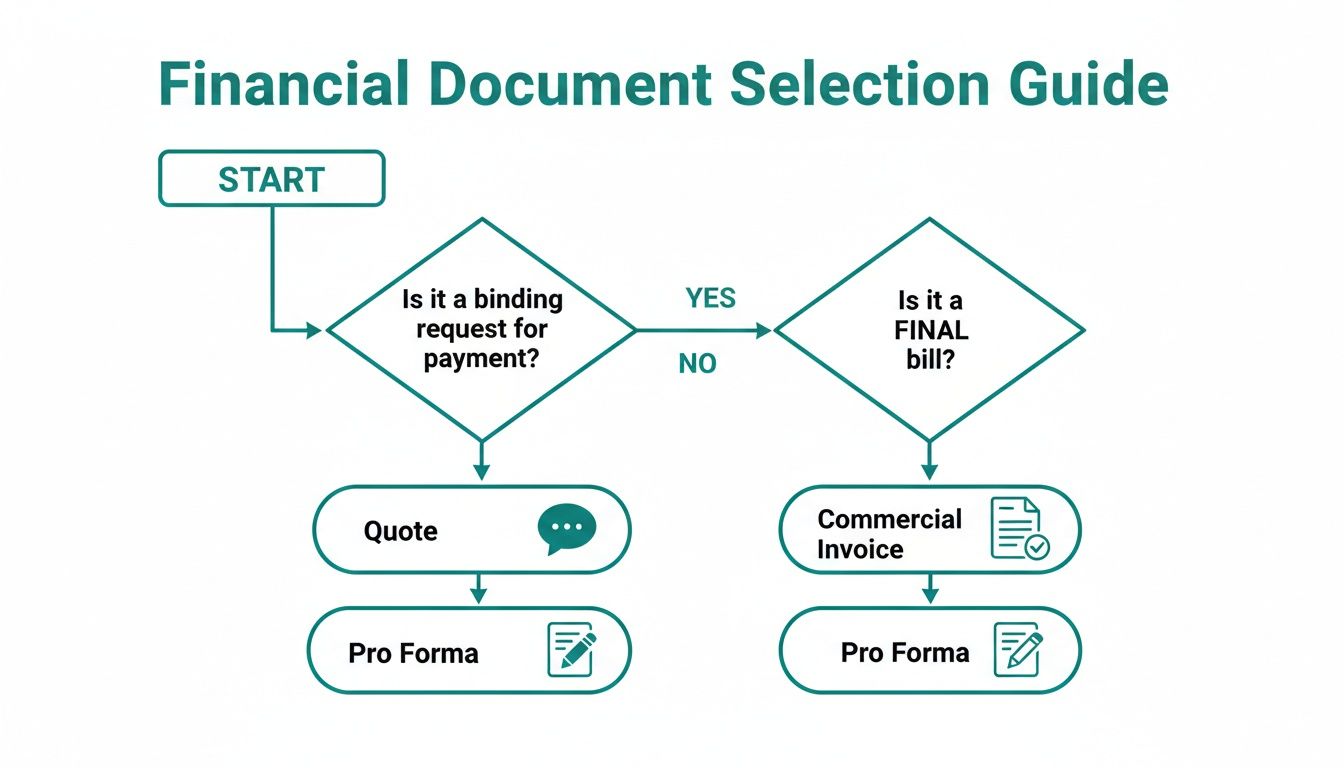
As you can see, the pro forma is a non-binding step that comes before the final bill. It’s a key part of sealing the deal, not the demand for payment itself.
The Role of Mintline in Dutch Transactions
Whether you start with a quote or a pro forma, keeping track of what comes next—the payment and the final invoice—is absolutely vital. This is exactly where a tool like Mintline comes in handy. It can automatically capture these preliminary documents and then link any prepayments directly to them.
By connecting the dots between a pro forma, a bank transaction, and the final commercial invoice, Mintline ensures your financial records are always complete and audit-ready. This eliminates the manual work of matching payments to agreements.
This kind of automation is a lifesaver for managing your company’s financial health. Properly tracking these documents is fundamental to managing your payables and receivables effectively, giving you a clear financial picture and helping to head off cash flow problems. When you use pro forma invoices correctly and lean on automation, you stay compliant and can get back to focusing on what really matters: growing your business.
Crafting an Effective Pro Forma Invoice
Even though a pro forma invoice isn't legally binding, how you put it together speaks volumes. A professional, clear document builds trust right away and stops misunderstandings before they even start. For anyone offering services, getting this right is a big part of the job, which is why guides on practices like invoicing for consultants are so helpful.
Think of it like a blueprint for the final deal. If that blueprint is sloppy or missing key details, you can bet the final build—the official invoice and payment—is going to run into trouble.
Essential Components of a Pro Forma Invoice
So, what exactly needs to be on this document? Every piece of information has a job to do in confirming the agreement with your client. Nail these details now, and creating the final commercial invoice later will be a breeze.
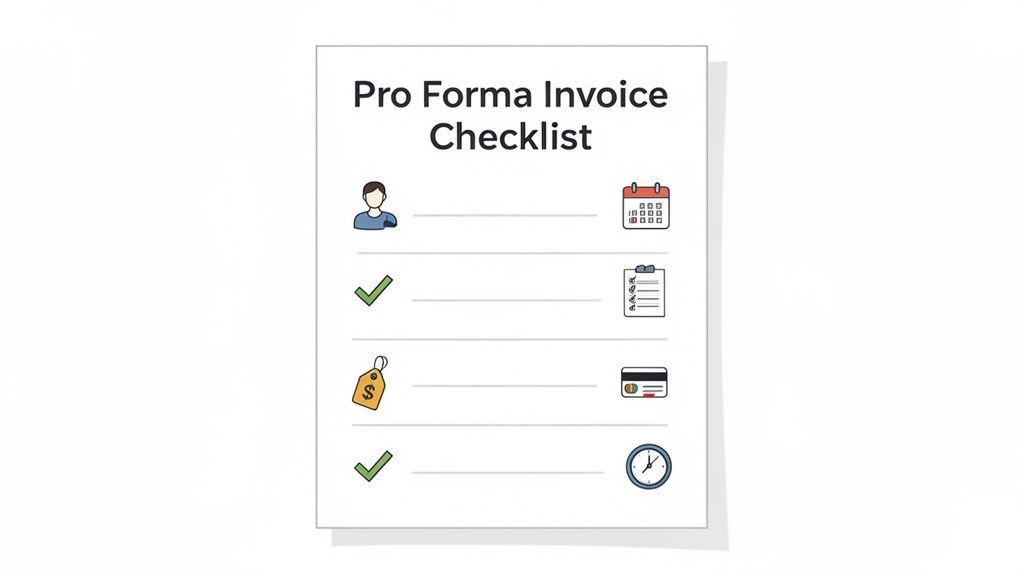
Here’s a simple checklist of what every pro forma needs:
- Clear Identification: The first thing anyone should see is the label "Pro Forma Invoice" right at the top. This instantly sets expectations and makes it clear it's not a final bill demanding payment.
- Seller and Buyer Details: Get the full name, address, and contact details for both your business and your client. You can't overstate the importance of accuracy here; it keeps communication lines wide open.
- Unique Document Number: Every document needs its own reference number. This is your key for tracking it internally and easily matching it up with purchase orders or the final invoice down the track.
- Issue and Validity Dates: Always include the date you created it and, crucially, a validity date (e.g., "Prices valid until 31 December 2024"). This is your safety net, protecting you from having to honour old prices if your own costs go up.
Detailing the Transaction Clearly
The heart of the pro forma is the breakdown of what you're actually selling. This is your chance to leave absolutely no room for doubt.
A detailed pro forma invoice is a powerful tool for transparency. By itemising every product, service, and cost, you provide the buyer with a complete picture of the transaction, which drastically reduces the chance of future disputes.
Make sure your breakdown includes:
- Itemised Goods or Services: Don't just list "Consulting work." Describe each product or service in detail. The more specific you are, the less chance there is for confusion.
- Quantities, Unit Prices, and Total Amount: For each item, list the quantity, the price per unit, and the total cost for that line. Then, add it all up for a clear subtotal.
- Applicable Taxes and Fees: While it’s not an official tax document, you should still include estimated BTW (VAT), shipping costs, or any other fees. Just be sure to label them clearly as estimates.
- Payment Terms: Outline the agreed-upon payment terms, like "50% prepayment required," even though this isn't the formal request for payment itself. It confirms the arrangement.
By including all these elements, you're not just sending a quote; you're creating a comprehensive, professional document that perfectly aligns expectations. A little preparation here makes the final invoicing process smooth and painless for everyone involved.
Automate Invoicing Workflows with Mintline
Let’s be honest: manually chasing pro forma invoices, then trying to match prepayments from your bank account to them, and finally connecting everything to a commercial invoice is a headache. It's a disjointed process that's a classic recipe for errors and eats up valuable hours. You're left with a confusing paper trail and disorganised books.
This is where smart automation completely changes the game. Instead of juggling spreadsheets and PDF folders, you can let an intelligent system connect all the dots for you. It creates a seamless and error-free workflow from the moment you agree on a price to the final payment record.
Bridging the Gap Between Agreement and Payment
Mintline was built to solve this exact challenge. Our AI-powered platform acts as the intelligent bridge between your preliminary agreements and your final accounting records. It understands that a pro forma invoice, while not an official bill, is a critical piece of the transaction's story.
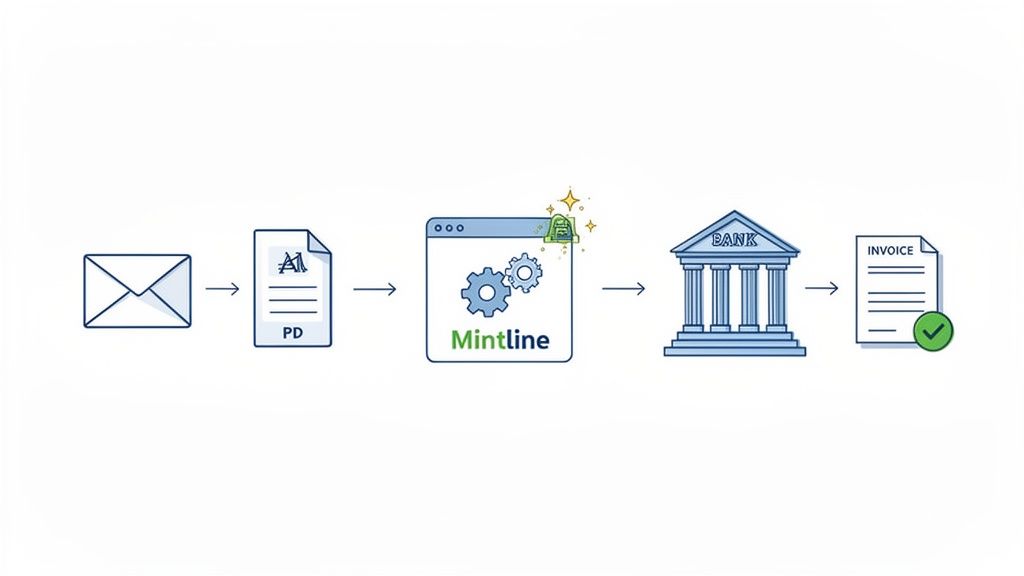
The process is refreshingly simple. Mintline automatically captures pro forma invoices that land in your email or that you upload as PDFs. When your customer makes a prepayment based on that document, our system intelligently links the incoming bank transaction directly to the corresponding pro forma.
This creates an instant, crystal-clear connection between the initial agreement and the money you’ve received. No more guesswork or manual searching to figure out what a payment was for.
From Pro Forma to Final Invoice—Automatically
But the workflow doesn't stop there. Once you issue the final commercial invoice, Mintline seamlessly matches it to the same transaction, effectively closing the financial loop.
What you're left with is a complete, audit-ready trail for every single transaction. Mintline connects the pro forma, the bank payment, and the final invoice into one unified record without you lifting a finger.
This kind of automation brings some serious benefits to the table:
- Drastically Reduced Errors: Manual data entry and matching are notoriously prone to human error. Automation ensures accuracy every single time.
- Hours of Admin Time Saved: What used to take hours of tedious admin work each month can now be handled in minutes.
- Perfectly Organised Books: Your financial records become cleaner and far more reliable, which makes month-end closing and tax prep much less stressful.
Here in the Netherlands, this level of precision is particularly important. Dutch invoicing rules demand strict attention to details like VAT IDs, KVK-numbers, and sequential numbering on final invoices. By automating the link between a pro forma, a bank statement, and the final VAT-compliant invoice, Mintline boosts document-to-transaction match rates to an impressive 95%. It turns a time-consuming chore into a simple background process.
By getting your invoicing workflow automated, you can finally stop chasing documents and get back to focusing on what really matters—growing your business. Find out more about how Mintline works to bring this efficiency to your operations.
Got Questions? Here’s What You Need to Know
Even when you’ve got the basics down, pro forma invoices can throw up a few tricky questions in the real world. Let’s tackle some of the most common ones we hear from freelancers and small business owners across the Netherlands, so you can handle these situations like a pro.
Can I Just Pop This Pro Forma Into My Dutch Accounting?
Absolutely not. Think of a pro forma as a placeholder, not the real deal. For the Dutch tax authorities (the Belastingdienst), a pro forma invoice has no official standing. It isn't a fiscal document and can't be used for your bookkeeping or BTW (VAT) returns.
When it comes to your records, only a final, official commercial invoice will do. That's the document that makes the transaction legally binding and keeps your accounts compliant and audit-proof.
My Client Paid the Pro Forma. Do I Still Need to Send a Final Invoice?
Yes, you do. Every single time. Even if the money is sitting in your bank account, the transaction isn't officially complete until you've sent a final commercial invoice after delivering the goods or services.
This final invoice is the official proof of sale for both you and your client. It formally closes the loop on the deal and provides the necessary paperwork for everyone's tax records. Don't skip this step – it's a legal requirement.
This is where a system like Mintline becomes a lifesaver. It keeps track of the payment you received against the pro forma and then automatically ties the final invoice to it. You get a clean, complete record without any of the manual busywork.
How Long Should I Hang Onto Pro Forma Invoices?
The official legal requirement in the Netherlands for keeping records—which is 7 years—applies to your final invoices and other core accounting documents, not the pro forma itself.
However, that doesn't mean you should toss it right away. It’s just good business to keep your pro forma invoices until the deal is done, paid for, and officially closed out in your books. It’s your proof of the original agreement.
If a client ever questions the price or the terms down the line, that pro forma is your best evidence. Keeping a digital copy, especially in a system that links it directly to the final invoice and payment, ensures everything is organised and easy to find if you ever need it.
Ready to stop chasing documents and start automating your finances? Mintline automatically captures pro forma invoices, links them to bank payments, and matches them with final invoices, creating a perfect audit trail in minutes. See how it works.