
A Practical Guide to RPA for Finance Automation
Discover how RPA for finance can streamline your operations. Learn key use cases, implementation steps, and how modern tools can transform your workflow.
Picture this: you have a digital team member who never sleeps, never makes a typo, and happily takes on your most mind-numbing financial chores. That, in essence, is Robotic Process Automation (RPA). It’s about using software 'bots' to handle the high-volume, rule-based tasks that clog up your finance team’s day, freeing them to focus on work that actually requires a human brain.
What RPA Actually Means for Your Finance Team
Let's be clear: we're not talking about physical robots at a desk. Think of RPA as a highly advanced macro that isn't confined to a single spreadsheet. Instead, this software bot can jump between all the different applications you use. It can log into your accounting system, open emails, pull data from a PDF, access your banking portal, and shuttle information from one place to another, all by following a strict set of rules you've defined.
This makes RPA for finance a natural fit. So many financial processes are incredibly structured and repetitive—the perfect playground for a software bot. They excel at the predictable, tedious jobs that are absolutely critical but eat up hours of your team's day. To really see how RPA can change your operations, it helps to first understand what business process automation entails and the core benefits it brings in terms of speed and savings.
The Digital Workforce in Action
So, what does this look like day-to-day? Imagine an employee manually downloading a bank statement, opening a spreadsheet, and then painstakingly copying and pasting every single transaction. Now, picture an RPA bot doing all of that automatically at 5 a.m., so the report is waiting in your team's inbox when they arrive.
This digital workforce is designed for perfect accuracy and consistency, wiping out the human errors that creep in from fatigue or a moment's distraction.
Here’s what makes them so effective:
- Rule-Based Operation: Bots are creatures of habit. They follow a pre-written script to the letter, which is ideal for tasks with clear, repeatable steps like invoice processing or data reconciliation.
- Cross-Application Functionality: A simple macro lives and dies in one program (like Excel). An RPA bot, however, can easily navigate between your email client, your ERP, and various web portals.
- 24/7 Availability: These bots don't need breaks. They can run month-end reports or reconcile accounts overnight, ensuring crucial information is ready for your team first thing in the morning.
By taking over these foundational tasks, RPA allows finance professionals to step away from being data entry clerks and become the strategic analysts the business needs them to be.
From Broad Platforms to Specialised Tools
While giant corporations might roll out huge, enterprise-wide RPA platforms, the core idea of automation is now available to businesses of any size through more focused tools. This is exactly where a solution like Mintline fits in.
Mintline is a prime example of specialised RPA, built to solve one of the most universal headaches in finance: matching receipts to bank transactions.
Instead of building a complex bot from scratch, you're using a tool where the automation is pre-built for a specific purpose. Mintline’s AI-driven system essentially acts as a highly specialised bot that reads bank feeds and receipts, intelligently connects the dots between them, and gets the data ready for your accounting software. It’s a perfect example of how targeted RPA for finance can deliver a clear, immediate return by giving businesses and accountants back their time.
Where RPA Makes a Real Impact in Finance
The real power of Robotic Process Automation isn't just theory; it's about what happens when you apply it to the high-volume, rules-driven tasks that bog down a finance team. These aren't just minor time-savers. We're talking about fundamentally changing how your team operates, delivering value you can see and measure almost immediately.
Let's dig into the areas where RPA for finance truly shines.
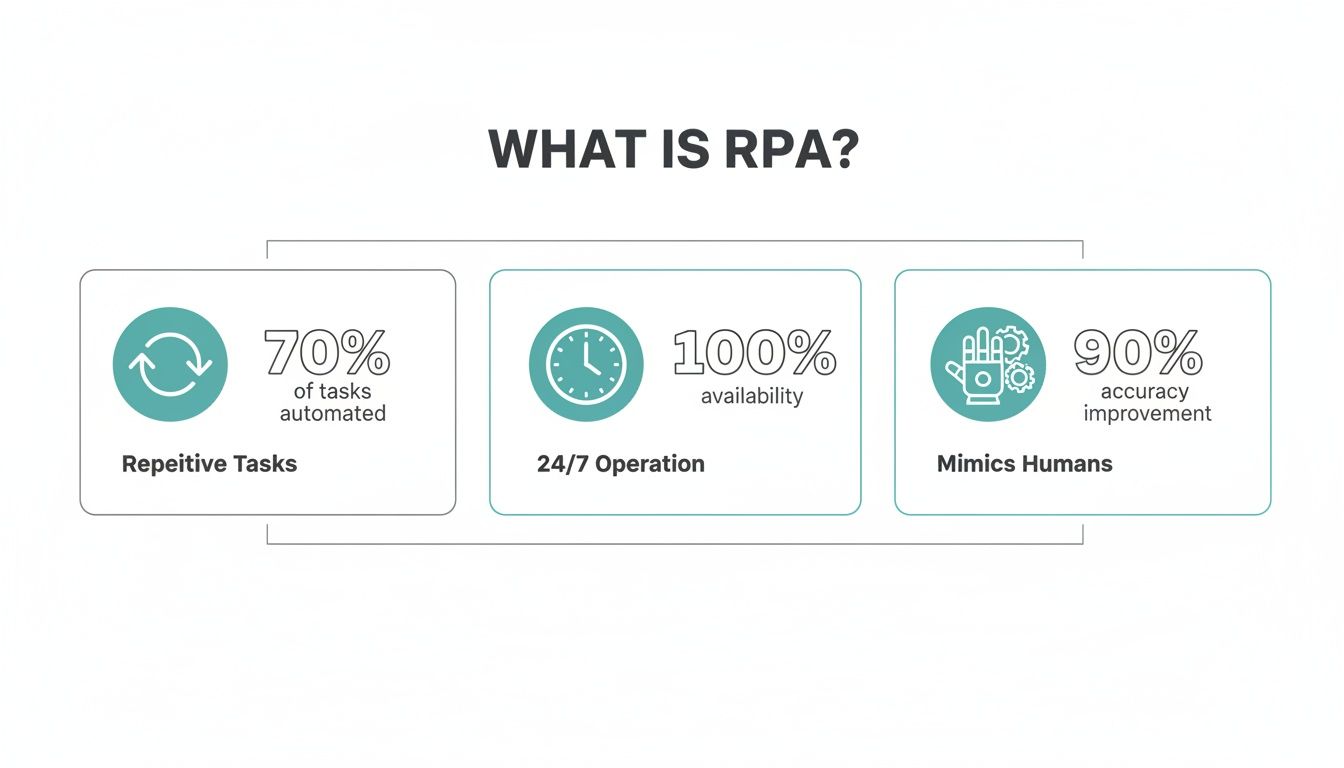
The bottom line is that software bots are built for endurance and precision. They execute processes flawlessly every single time, without ever needing a coffee break.
Transforming Accounts Payable and Receivable
If there's one area practically begging for automation, it's Accounts Payable (AP). Think about the manual grind: an invoice arrives, someone keys the data into the accounting system, routes it for approval, and then schedules the payment. It's a chain of repetitive, mind-numbing steps.
An RPA bot can take over this entire workflow. It can be set up to watch an inbox for new invoices, use Optical Character Recognition (OCR) to pull out key details—vendor name, invoice number, amount—and plug that data straight into your accounting software. It can even chase approvals and flag anything unusual for a human to look at. For a deeper dive, see how dedicated accounts payable automation software can modernise this critical process.
Accounts Receivable (AR) sees similar gains. An RPA bot can easily be programmed to:
- Automatically generate and send invoices the moment a sales order is complete.
- Keep an eye on payment statuses and send out polite, scheduled reminders for overdue accounts.
- Instantly update customer records once a payment lands.
This level of automation means you get paid faster, your cash flow becomes more predictable, and your team is freed from chasing paperwork.
The table below breaks down exactly how these manual tasks evolve with RPA.
Transforming Finance Tasks From Manual to Automated
| Financial Process | Manual Task Example | Automated With RPA | Key Benefit |
|---|---|---|---|
| Accounts Payable | Manually keying in invoice data from a PDF into an ERP system. | A bot extracts data using OCR and enters it into the system automatically. | 90% faster processing, massive reduction in data entry errors. |
| Accounts Receivable | An AR clerk manually sending email reminders for overdue invoices. | A bot monitors due dates and sends automated, tiered payment reminders. | Improved cash flow, reduced Days Sales Outstanding (DSO). |
| Expense Matching | An employee spends hours matching receipts to bank statement lines. | A specialised tool like Mintline auto-matches receipts to transactions. | Drastically cuts down on admin time, ensures audit-ready records. |
| Financial Reporting | A controller pulls data from 3 different systems to build a monthly P&L. | A bot logs into each system, gathers the data, and populates a report template. | Faster, more accurate month-end close; consistent reporting. |
This shift isn't just about efficiency; it's about elevating your finance team from data entry clerks to strategic analysts.
Modernising Expense Management with Specialised Tools
Expense management is a notorious bottleneck, a headache of chasing receipts and mind-numbing reconciliation. This is where a specialised RPA tool like Mintline really shows its worth. Instead of a team member losing hours manually digging through a folder of receipts to match each one to a bank statement line, Mintline’s AI-powered bot does it in seconds.
Think of it as a focused RPA solution. It connects to your bank feed or reads your PDF statements, uses intelligent OCR to understand the receipts, and then uses AI to link them to the right transaction based on vendor, date, and amount. What was once a multi-hour, error-prone chore becomes a quick, final review. It’s a perfect, tangible example of RPA for finance in action.
Here in the Netherlands, a major hub for European financial innovation, RPA adoption has been impressive. A recent report showed that Dutch financial institutions have automated over 40% of their repetitive back-office tasks, leading to an average cost reduction of 35% in compliance alone. For freelancers and small businesses using tools like Mintline, this reflects how automation can slash the hours spent on manual bank statement matching. Imagine turning 20 hours of monthly admin into less than 2.
Streamlining Financial Reporting and Compliance
Putting together regular financial reports—like P&L statements or cash flow analyses—means pulling data from multiple places. An RPA bot can be configured to log into your CRM, accounting software, and various spreadsheets to gather all the required information.
Once it has the data, the bot consolidates it and drops it into your pre-defined report templates. This guarantees that your reports are generated quickly and consistently, whether it's for month-end or quarter-end.
When it comes to compliance, RPA is your best friend for maintaining a perfect audit trail. Bots log every single action they take, creating a transparent, chronological record of every automated process. This is invaluable for regulatory reporting, as it provides clear proof that tasks were performed exactly according to the rules, reducing risk and making audits far less painful.
Your Step-by-Step RPA Implementation Plan
Getting started with RPA doesn't mean you have to rip out your existing systems and start from scratch. For finance teams, the best approach is a structured one that delivers results quickly. By breaking the process down into clear, manageable stages, you can bring automation into your department with confidence and see a strong return on your investment.
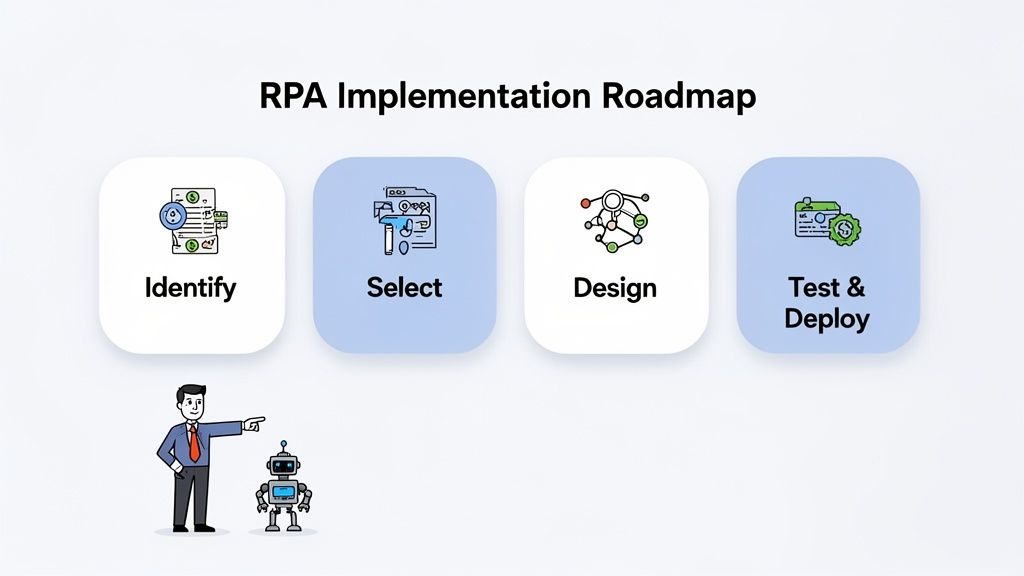
This four-stage plan is a practical roadmap for getting RPA for finance right the first time.
Stage 1: Identify and Prioritise
Before a single bot gets built, you need to find the right opportunities. Let's be clear: not every task is a good fit for automation. The sweet spot is always a process that's highly repetitive, driven by clear rules, and deals with a high volume of transactions.
Start by getting your team to map out their daily and weekly workflows. Ask them straight up: what are the most mind-numbing, error-prone tasks they have to do? You're looking for things like manual data entry, routine report generation, or reconciliations that follow the exact same pattern, every single time.
Great places to start your first RPA project often include:
- Invoice data entry, where someone is manually copying details from a PDF into your accounting software.
- Bank statement reconciliation, which involves the tedious job of matching line items against receipts or invoices.
- Generating standard weekly financial reports by pulling data from the same handful of sources.
Choosing a process that is both high-volume and low-complexity is the key to a quick win. It builds momentum and gets your team excited about what’s next.
Stage 2: Select the Right Tools
The RPA market can feel overwhelming. It ranges from massive, complex platforms for huge corporations to focused, user-friendly solutions. For most small and medium-sized businesses, a specialised tool is the smartest and most affordable way to get into RPA for finance.
While the big enterprise platforms offer incredible flexibility, they often come with a steep price tag and require serious technical expertise to set up and manage. In contrast, specialised tools like Mintline are pre-built to solve a specific, nagging financial problem right out of the box, with no coding needed.
Think about it this way: instead of building a bot from scratch to handle expense management, you can adopt a solution where the automation is already perfected. Mintline, for example, acts as a dedicated bot for automatically linking bank transactions to receipts—a task every single business deals with.
This approach delivers value from day one, without the long learning curve. The goal is to find a tool that solves a real headache for your team right now. If your biggest challenge is a mountain of paperwork, then looking into platforms focused on automated document processing is the most logical next step.
Stage 3: Design and Configure
With your process and tool chosen, it's time to design the automation workflow. This means mapping out every single click, keystroke, and decision the bot will need to make. Think of it as writing an incredibly detailed recipe for a robot chef.
You need to document everything. For example, if you're automating invoice processing, your map would include steps like: "Open email inbox," "Find emails with 'Invoice' in the subject," "Download the PDF attachment," and "Extract the value from the 'Invoice Number' field."
Luckily, modern low-code tools have made this part much easier than it used to be. Solutions like Mintline simplify this stage by handling the really complex bits—like OCR and AI matching—behind the scenes. For you, configuration is as simple as connecting your bank account or uploading statements, and the tool's pre-built logic handles the heavy lifting.
Stage 4: Test and Deploy
Never, ever roll out a new automation to your entire operation at once. The final, crucial stage is to test your bot in a controlled environment before you set it loose. Start with a pilot phase, using a small but representative sample of data.
This is your chance to iron out any wrinkles and make sure the bot behaves exactly as you expect. During testing, you’ll want to check for accuracy, speed, and how it handles exceptions, like an invoice in an unexpected format. Once you’re confident in its performance, you can gradually give it more work.
A good rule of thumb is to start by having the bot handle just 10% of the transaction volume while your team keeps a close eye on it. As the bot proves its reliability, you can scale it up. This phased rollout minimises risk and helps your team get comfortable with their new digital colleague.
Measuring the True ROI of Finance Automation
So, you're thinking about automating your finance processes. The first thing that probably comes to mind is saving a bit of time, right? But that’s honestly just scratching the surface. The real value of RPA for finance runs much deeper than simply cutting a few hours of work. To really see the full picture, you have to look at both the hard numbers and the less obvious, but just as crucial, improvements to how your team operates.
Getting a clear view of this value is how you build a solid business case for automation and get everyone, from the CFO to your team on the ground, on board. It starts by looking past the obvious savings.
Beyond Simple Labour Cost Savings
It’s easy to focus on the most direct win: reduced manual labour. If you have a person spending ten hours a month on a task that a bot now handles in minutes, the maths is simple. But that's just the tip of the iceberg. The real ROI comes from what happens with all that time you've just freed up.
Think about how fast your financial cycles run. Automation can put a jet engine on critical processes, which gives your business a serious competitive edge.
Here are a few key performance indicators you should be tracking:
- Faster Month-End Close: How many days does it take to close the books? If you can shrink that from, say, ten days down to three, your team gets to focus on strategic planning much earlier in the month.
- Reduced Invoice Processing Time: Clock the average time from when an invoice lands on your desk to when it’s paid. Getting this done faster often means you can snag early payment discounts and keep your suppliers happy.
- Quicker Expense Reimbursements: Nobody likes waiting to get paid back. Monitor how long it takes to approve and pay employee expenses. A quick turnaround is a simple but powerful way to boost morale.
The real return on investment isn't just the salary cost of the hours saved; it's the value created by a faster, more agile finance function that can provide critical business insights sooner.
The Financial Impact of Improved Accuracy
Let’s be honest, manual data entry is a recipe for mistakes. A single misplaced decimal point or a mistyped invoice number can lead to overpayments, compliance headaches, and hours of frustrating rework trying to find the source of the problem. Automation all but eliminates these human errors, and the financial benefits stack up quickly.
Some studies suggest automated systems can boost data accuracy by over 90%. That’s a number that translates directly into savings. You're not just saving on labour costs spent hunting for discrepancies; you're also dodging the financial bullets of incorrect payments or regulatory fines. This is precisely where the audit-proof nature of tools like Mintline becomes so valuable. By generating clean, perfectly matched records ready for your accounting system, it builds a rock-solid foundation of accuracy.
Valuing the So-Called Soft Benefits
Not every win from RPA for finance fits neatly into a spreadsheet, but that doesn't mean they're any less important. These “soft” benefits have a massive impact on your company's culture, agility, and long-term health.
Just think about your team’s morale. When you take the mind-numbing, repetitive data entry off the plates of skilled finance professionals, they can finally put their brains to work on more strategic and engaging tasks. This shift doesn’t just make them happier—it makes them more valuable. Suddenly, they're focused on financial analysis, forecasting, and planning for the future. Better morale also leads to lower employee turnover, which brings its own set of savings on recruitment and training.
Integrating RPA with Your Existing Finance Software
RPA isn't about throwing out your current finance software and starting from scratch. Far from it. The real magic happens when RPA bots work with the tools your team already uses every day, like your ERP, accounting platform, and banking portals. The goal is to build a connected digital workforce, not an isolated one.
Think of it this way: the biggest bottlenecks in finance often happen when someone has to manually copy information from one system and paste it into another. RPA for finance bridges those gaps. The key to making this happen is something called an API (Application Programming Interface).
An API is like a universal translator for software. It lets completely different applications speak the same language, share data, and trigger actions in one another. This is how an RPA bot can pull an invoice from your email, cross-reference it with a purchase order in your ERP, and then log the payment in Xero or QuickBooks without a person ever touching a keyboard.
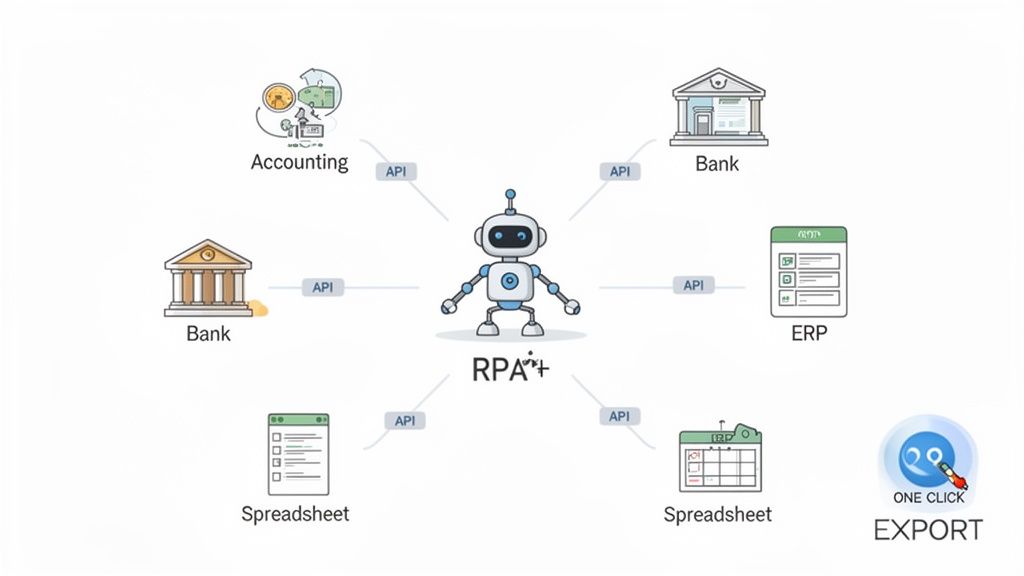
This free-flowing exchange of information is what removes the friction, delays, and inevitable human errors from your financial processes.
The Power of a Connected Ecosystem
When your systems are all talking to each other, you create a seamless, end-to-end workflow. Imagine a bot that watches a specific inbox for supplier invoices. The moment one lands, it kicks off a chain reaction.
The bot can instantly connect to your accounting software to check for a matching purchase order, ping your inventory system to confirm the goods were received, and then queue up the payment in your banking portal for approval. Each step is automated, logged, and completely transparent, leaving your team to manage only the exceptions.
This is the difference between simply automating a few standalone tasks and building a truly intelligent finance function.
Specialised Tools Complementing a Broader Strategy
While broad RPA platforms are fantastic for automating a wide variety of rules-based processes, some tasks are so specialised they need a purpose-built tool. This is where a solution like Mintline slots perfectly into your automation strategy.
You could use a general RPA bot to pull month-end reports, but teaching it the complex, nuanced art of matching hundreds of messy receipts to bank transactions is another challenge entirely. That's a job for a specialist.
Mintline is essentially a pre-built, expert bot designed for that one critical job. It uses advanced AI to do something that would be incredibly difficult and time-consuming to build from the ground up with a general RPA tool.
By plugging a specialised tool into your workflow, you get the best of both worlds: the broad power of general RPA for your core processes and the deep, focused expertise of a tool like Mintline for a high-volume, critical pain point.
This approach is not only more effective but also much more practical. The technology that powers this kind of intelligent matching, as you can read in this guide to modern OCR recognition software, is a key piece of the automation puzzle.
Mintline’s one-click export feature is a perfect example of this integration in practice. After its AI has done the heavy lifting of matching transactions and receipts, the data doesn't just sit there. With a single click, it pushes perfectly organised, audit-ready data straight into your accounting system. This closes the loop, turning a stream of raw bank data into perfectly reconciled books and delivering on the true promise of RPA for finance.
Avoiding Common Pitfalls in RPA Adoption
While the potential of RPA for finance is huge, the road to automation is littered with traps. Just buying a tool and hoping for the best is a recipe for disaster. A bit of foresight is needed to avoid the common mistakes that can derail your project and kill your return on investment.
One of the first and biggest hurdles is picking the wrong process to automate. It’s tempting to go for the most complicated, time-consuming task on your list, but that's usually the wrong move. RPA bots are brilliant at repetitive, rules-based work. They struggle with tasks that need human judgment, creative thinking, or making sense of messy, unstructured information. If you try to automate a process that's constantly changing or has a ton of exceptions, you’ll end up with a fragile bot that breaks every five minutes.
Standardise Before You Automate
Another classic mistake is trying to automate chaos. If five people on your team do the same job in five different ways, a bot won't magically solve that inconsistency. In fact, it's pretty much guaranteed to fail.
Before you even think about building a bot, you have to nail down the process. Map out every single step, get rid of anything that isn't adding value, and create one single, streamlined workflow for everyone to follow. Automating a clean process is simple. Automating a mess is a nightmare.
Prioritising Data Security in Automation
In finance, security isn't just a nice-to-have; it's everything. When you let software bots loose on sensitive financial data, you're adding a new layer to your security setup. Ignoring this can lead to serious trouble. Think of each bot as a digital employee—it needs its own login credentials and access rights, which should be locked down to the bare minimum it needs to do its job.
This is where you have to be incredibly demanding of any automation tool you're looking at. For example, a tool like Mintline was built from the ground up with security in mind, because financial data is non-negotiable. Key security measures to insist on include:
- Strong Encryption: Your data needs to be locked down, whether it's sitting on a server or being sent across the internet. Mintline uses AES-256 encryption, the same bulletproof standard used by major banks.
- Secure Data Storage: You need to know exactly where your data is stored, especially with regulations like GDPR. Choosing a provider that uses EU-based data centres on a secure cloud platform gives you a crucial layer of compliance and peace of mind.
- Access Controls: Implement tight user permissions so that only the right people can build bots or see the information they handle.
By getting ahead of these common issues—picking the right process, standardising it first, and baking in security from day one—you lay a strong foundation for an RPA for finance programme that actually delivers.
Common Questions About RPA for Finance
As finance teams start looking into automation, a few questions always pop up. Getting to grips with the specifics of RPA for finance helps clear up any confusion and paves the way for a smoother rollout. Let's tackle some of the most common queries to give you a clearer picture.
These aren't just technical questions; they get to the heart of what it really means to bring automation into your day-to-day finance work.
Is RPA the Same as AI and Machine Learning?
It's a great question, and the simple answer is no—but they work brilliantly together. Think of it this way: RPA is like a pair of digital hands, perfectly following a set of pre-programmed instructions to get a task done. AI and Machine Learning (ML) are the "brains" behind the operation, capable of learning from data and making smart decisions.
For instance, a tool like Mintline uses RPA principles to shuttle data around. But the real magic happens when its AI-powered OCR and ML step in to intelligently "read" a receipt and figure out which bank transaction it belongs to, even if the vendor name or date is slightly off. Standard RPA just follows the script; AI-powered RPA can improvise.
The best automation solutions today aren't just one or the other. They blend the reliable, rule-based work of RPA with the smart, adaptive thinking of AI to create something truly powerful.
Is RPA Only for Large Corporations?
That’s a common misconception. While the big players were certainly the first to jump on board, the game has changed completely. Thanks to a new wave of user-friendly, cloud-based tools, RPA is now well within reach for businesses of all sizes. In fact, solutions like Mintline were designed from the ground up for freelancers, start-ups, and SMBs.
You no longer need a massive IT budget or a dedicated team of developers to get started. You can begin small by automating just one repetitive process that causes the most headaches—like expense reconciliation—and build from there. It's all about finding the right tool for the job.
How Should I Prepare My Team for RPA?
This is probably the most important question of all, and it comes down to two things: communication and involvement. The last thing you want is for your team to feel like they're being replaced. Frame it as a way to empower them, freeing them from the soul-crushing tasks they hate.
A great first step is to ask them directly: "What's the most tedious, repetitive part of your job?" Getting them involved in picking the first process to automate builds immediate buy-in.
Then, focus on training them to use the new tools and show them how their roles will shift from mind-numbing data entry to more valuable analysis and strategy. When you get that first win—like showing everyone how many hours were saved in the first month—celebrate it. That's how you build momentum and get everyone excited for what's next.
Ready to see how a specialised RPA for finance tool can take the pain out of your expense management? With Mintline, you can automate the entire process of matching receipts to bank transactions, saving you hours every month and keeping your books perfectly audit-ready. Start for free on https://mintline.ai and feel the difference that focused automation makes.