
Automating Accounts Payable: The Modern Finance Guide with Mintline
Discover how automating accounts payable can transform your finance team. This guide covers benefits, key features, and implementation steps for real results.
Automating your accounts payable is about more than just swapping paper for pixels. It’s about leveraging smart software like Mintline to handle the entire invoice-to-payment lifecycle, freeing up your team from the manual grind. This strategic shift can slash invoice processing times by a massive 80% and virtually eliminate costly data entry mistakes.
The True Cost of Manual Invoice Processing
If your finance team is buried under a mountain of paper invoices, constantly chasing approvals, and manually punching numbers into a spreadsheet, you know the frustration. But that daily struggle is more than just an annoyance; it's a quiet but constant drain on your business's resources.
Picture a typical accounts payable department stuck in this loop. Every day brings a new pile of invoices, each one needing to be manually checked, coded, and then physically routed for someone's signature. This old-school way of doing things costs a lot more than you might think.

The problems with manual AP run deep, affecting everything from your team's morale to your company's bottom line. The process is slow by its very nature and wide open to human error, leading to headaches like paying the same invoice twice or entering the wrong amount—mistakes that can take hours of detective work to fix. If you want a refresher on the basics, our guide on what is accounts payable explains why getting this process right is so critical.
Uncovering the Hidden Financial Drains
Beyond the obvious operational drag, manual AP has a way of quietly bleeding money from your business. These financial leaks often fly under the radar until they add up to a serious problem. A big part of the issue is the sheer chaos of managing documents, a challenge that can be sorted out by setting up automated document workflows.
Think about these common pain points and how they hit your wallet:
- Missed Early Payment Discounts: When it takes weeks to get an invoice approved, you forfeit the chance to grab those valuable discounts suppliers offer for paying early. Even 1-2% off can add up to huge annual savings.
- Wasted Team Hours: Your skilled finance pros are stuck doing low-impact admin work—data entry, filing, follow-up emails—when they could be focused on strategic financial analysis that actually grows the business.
- Increased Risk of Fraud: Paper-based systems are a prime target for both internal and external fraud. Without a clear digital audit trail, spotting suspicious invoices or duplicate payments before the money goes out the door is incredibly difficult.
Automating accounts payable is a strategic shift. It’s not just about adopting new software; it’s about transforming your finance function from a reactive cost centre into a proactive driver of business value.
This is exactly what Mintline is designed to do. By getting rid of these operational bottlenecks, our platform empowers your finance team to work faster, more accurately, and with greater strategic focus. It turns a major source of business friction into a real competitive advantage.
How AP Automation Delivers Real Business Value
Let's cut through the jargon. When we talk about automating accounts payable, we're not just talking about moving faster. We're talking about a fundamental shift that directly strengthens your company’s financial core. The real value comes down to three things: slashing costs, boosting your team's efficiency, and gaining rock-solid financial control.
Switching to an automated system like Mintline is an immediate attack on the surprisingly high cost of handling invoices by hand. Think about it – studies have shown that manual processing can cost as much as £15 per invoice. With automation, that number plummets. Why? Because you’re wiping out countless hours spent on mind-numbing data entry and shuffling paper from desk to desk.
This isn't just about small savings, either. Automation opens the door to cost-cutting opportunities you simply couldn't grab before. Take early payment discounts, for example. A simple 1-2% discount for paying an invoice a few days early might not sound like much, but it can easily add up to thousands of pounds in savings over a year.
Supercharge Your Operational Efficiency
This is where you see the most dramatic change. Automation turns your AP process from a slow, administrative headache into a fast-moving, strategic part of your finance function. The old way of doing things—printing invoices, physically walking them to a manager for a signature, and then chasing approvals over email—is a recipe for delays.
With a platform like Mintline, a cycle that used to take weeks is crunched down to hours, sometimes even minutes. Invoices arrive digitally, get routed to the right person based on rules you’ve already set, and are approved with a quick click. Suddenly, your finance team is freed from the daily grind.
Instead of burning 8-10 hours every week just chasing down paperwork, they can now focus on work that actually moves the business forward, like:
- Cash Flow Analysis: Getting a live, accurate picture of your liabilities to make smarter financial calls.
- Supplier Relationship Management: Using prompt payments as leverage to negotiate better terms and build stronger partnerships.
- Budget Forecasting: Supplying leadership with precise, up-to-the-minute data for financial planning you can actually trust.
This shift turns your AP team from back-office administrators into strategic partners. To see how these gains stack up, you can explore the top benefits of accounts payable automation in more detail.
Establish Ironclad Financial Control
Perhaps the most crucial improvement from automating your AP is the level of financial control and security you gain. Let’s be honest: manual, paper-based systems are risky. They leave you wide open to fraud, compliance headaches, and incredibly painful audits.
Automation changes the game by creating one central, transparent system where every single action is tracked. This complete digital audit trail is your new single source of truth, making it incredibly easy to see who approved what, and when.
"Before Mintline, month-end was a nightmare of chasing receipts and manually matching transactions. Now, we close our books 70% faster. The digital trail makes audits painless, and I have complete confidence in our financial data."
This kind of control is vital for stopping fraud, both internal and external. An automated system can instantly flag a duplicate invoice or suspicious vendor details that a busy human might easily miss. What’s more, platforms like Mintline build your business rules right into the workflow. This enforces compliance automatically, guaranteeing that every payment is properly authorised before it ever leaves your bank account. It’s a proactive defence that protects your bottom line and gives you some much-needed peace of mind.
Your Roadmap to Implementing AP Automation
Making the switch to an automated system can feel like a massive undertaking, but it doesn't have to be a headache. The secret to a successful transition is breaking the journey down into clear, manageable stages. This practical roadmap will guide you through the process, helping you move towards automating accounts payable with confidence.
Start by Mapping Your Current Process
The first step has nothing to do with software. It’s all about getting a brutally honest look at your current reality. Before you can improve anything, you need a crystal-clear picture of how invoices are handled today, from the moment one lands in an inbox to the final payment confirmation.
Get granular. Document every single touchpoint, every manual handoff, and every approval loop. Who is involved at each stage? What tools are they using—email chains, clunky spreadsheets, physical stamps? This is where you’ll pinpoint the real bottlenecks, like that one manager who consistently takes a week to approve an invoice. These pain points are the foundation of your business case.
Define What Your New System Must Do
Once you’ve identified the weak spots in your current setup, you can start defining what you actually need from a new system. This isn't a vague wish list; it's a set of concrete requirements that will steer your search for the right solution. Focus on the specific outcomes you're trying to achieve.
Your requirements should be specific and measurable. For example, instead of a goal like "we need it to be faster," a much stronger requirement is "the system must reduce our average invoice processing time from 14 days to 3 days."
Think about these key areas when building out your list:
- Core Functionality: What are the absolute must-haves? This could include AI-powered invoice capture, automated three-way matching, and approval workflows you can customise on the fly.
- Integration Needs: How will this platform talk to your existing tech stack? Seamless integration with your ERP or accounting software is non-negotiable if you want to maintain a single source of truth for your financial data.
- User Experience: The most powerful system in the world is useless if your team hates using it. It needs to be intuitive and easy to navigate, demanding minimal training to get people up and running.
Build a Compelling Business Case
With your requirements clearly defined, it's time to build a business case that gets your stakeholders on board. This is where you connect the dots between operational goals and the company's financial health. You have to demonstrate that automating accounts payable isn't just a nice-to-have convenience—it's a smart investment with a clear and predictable return.
A strong business case moves beyond operational improvements and speaks the language of financial impact. It clearly articulates how automation will reduce costs, mitigate risks, and free up resources for strategic growth.
This is where your initial deep dive really pays off. Use the hard data you gathered on wasted hours, missed early-payment discounts, and costly human errors to quantify the price of doing nothing. Present a clear financial projection showing the expected ROI, not just from lower processing costs but also from the discounts you'll finally be able to capture.
The diagram below shows exactly how AP automation delivers value by tightening up costs, efficiency, and control.
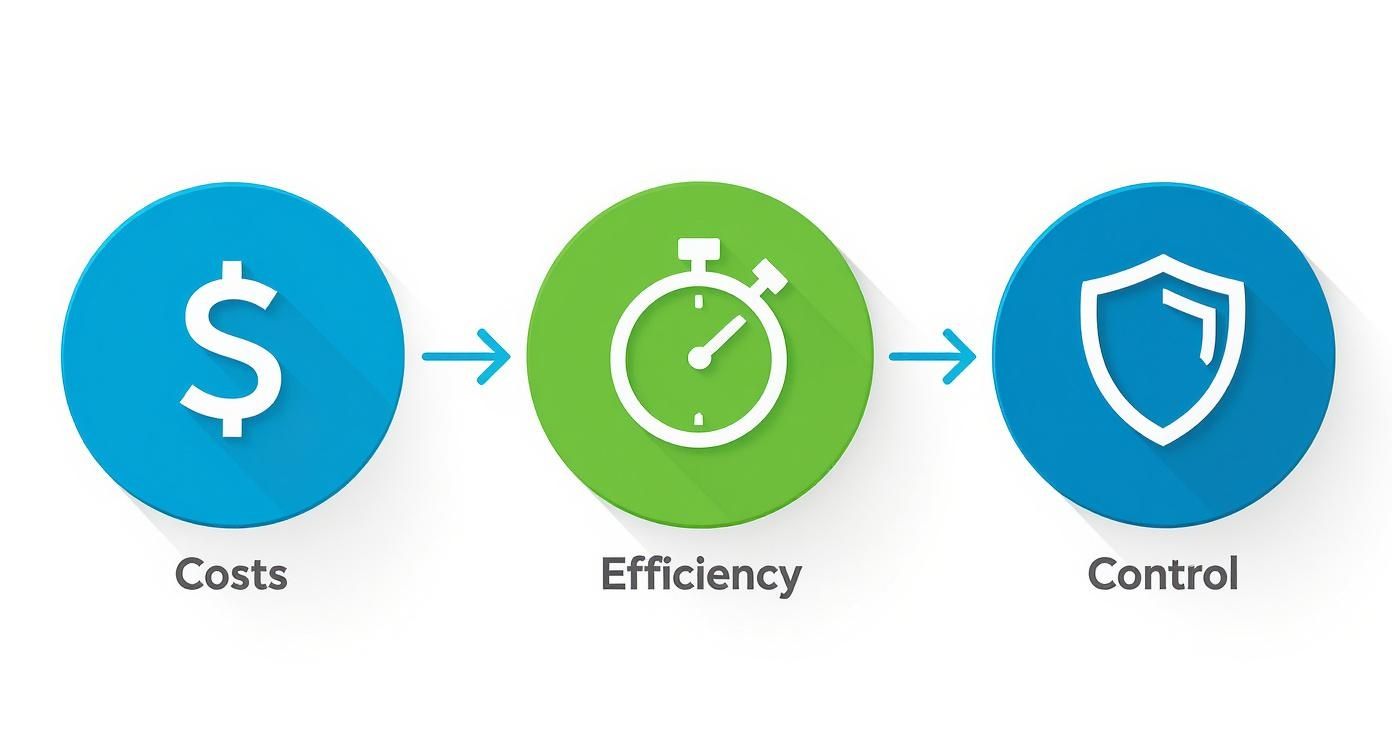
This visual flow makes it easy to see how each stage of automation builds on the last, creating a much stronger and more resilient financial operation.
Choose Your Partner and Drive Adoption
Selecting the right vendor is a huge milestone. Don’t just look for a provider; look for a partner who takes the time to understand your specific challenges and offers dedicated support. A platform like Mintline, for instance, is built for rapid deployment and comes with expert guidance to ensure a smooth transition from day one.
In the Netherlands, the appetite for this change is particularly strong. A remarkable 76.5% of Dutch finance professionals support more investment in automation, seeing its obvious potential. But they also see a major roadblock: 29.6% point to a lack of internal knowledge as the biggest hurdle. This just underscores how vital it is to choose a partner that provides excellent training and ongoing support. To dig deeper into these numbers, you can explore the full report on finance automation.
Finally, the project's ultimate success hinges on your team actually using the new system. Don't underestimate the importance of change management. Communicate the benefits early and often, focusing on how the new tool will make their jobs less tedious and more strategic. Provide thorough training, celebrate early wins to build momentum, and make sure your investment delivers its full potential.
Essential Features of a Modern AP Automation Platform
Not all AP automation platforms are created equal. When you start looking at your options, it's easy to get lost in flashy marketing, but what really matters is the core functionality underneath. A truly modern system is built on a specific set of features that are absolutely non-negotiable if you want to see real efficiency and control.
Think of these features as the engine of your new AP process. Without them, you’re just trading one set of manual headaches for another. A powerful solution, like the one we've built at Mintline, weaves these essential components into a single, seamless system that genuinely changes how your finance team works.
Intelligent Invoice Capture
First things first: you have to get rid of manual data entry. Your team’s time is far too valuable to be spent keying in details from PDFs or paper invoices. A top-tier platform uses a combination of Optical Character Recognition (OCR) and Artificial Intelligence (AI) to handle this automatically.
But this isn’t just about reading text off a page. The technology intelligently identifies and pulls out the crucial information—vendor name, invoice number, date, line-item details, and the total amount—with incredible accuracy. This is the foundation of straight-through processing. By digitising and structuring invoice data the second it arrives, you're setting the stage for a completely automated workflow. To dive deeper into how this works, check out our guide on intelligent document processing.
Mintline's smart system also learns on the job. If it sees a new invoice layout from a regular supplier, our AI quickly figures it out, making sure the next invoice from them is processed even faster and more accurately. This ability to adapt is what separates a truly intelligent platform from a basic one.
Automated Three-Way Matching
Once the invoice data is captured, the next critical step is making sure it's correct. For any business that relies on purchase orders (POs), automated three-way matching is a massive leap forward for financial control. This feature automatically cross-references the invoice with its corresponding PO and the goods receipt note.
It’s an automated check that instantly answers three critical questions: Did we order this? Did we receive it? And are we being billed the right amount for it?
A modern AP platform can do this in seconds, a task that might take a person minutes, or even hours, to complete manually. If all three documents line up perfectly, the invoice can be cleared for payment without anyone needing to lift a finger. But if there’s a mismatch—say, the price on the invoice is higher than on the PO, or the quantity is off—the system immediately flags it and sends it to the right person to investigate.
This doesn't just speed up approvals; it acts as a powerful line of defence against overpayments and potential fraud. It’s how you make sure you only ever pay for exactly what you ordered and received.
Dynamic Approval Workflows
Your business has its own way of doing things, and that includes who needs to sign off on payments. A rigid, one-size-fits-all approval chain simply doesn’t work. This is why customisable, dynamic approval workflows are another must-have feature.
A great platform will let you build multi-step approval chains based on your own internal rules. You should be able to create logic based on criteria like:
- Invoice Amount: Invoices over £5,000 could automatically go to a department head, while smaller ones go straight to a manager.
- Supplier: All invoices from a key strategic partner might need a final look from a senior executive.
- Department or GL Code: Marketing expenses get routed to the CMO, while IT costs are sent to the CIO.
The best systems make this incredibly easy to set up, with no IT help required. Platforms like Mintline use a simple drag-and-drop interface, allowing you to map out a logical flow that reflects how your business actually operates. This ensures every payment is properly authorised without creating bottlenecks.
Finally, seamless ERP integration is the glue that holds everything together. The platform has to connect flawlessly with your existing accounting software to create a single source of truth for your financials. This kills off duplicate data entry for good, keeps your general ledger perfectly up-to-date, and makes month-end reporting faster and far more reliable.
Measuring the Success of Your AP Automation
So, you’ve implemented a new AP automation system. Now for the million-dollar question: was it worth it?
To truly understand the value of your investment, you need to look past the general feeling of "things are better now" and dive into the hard numbers. This is where Key Performance Indicators (KPIs) come in. They’re the proof in the pudding.
Think of these metrics as the language of efficiency. They’re how you translate operational improvements into a clear story about cost savings and strategic value. When you track the right KPIs, you can show anyone in the business exactly how a platform like Mintline is making a measurable difference.
Key Metrics for AP Performance
To get the full picture, you’ll want to focus on a handful of core metrics that cover speed, cost, and accuracy. Each one tells a part of the story of how automation is reshaping your AP process.
Let's dig into the most important ones.
-
Invoice Cycle Time: This is the big one. It’s the total time it takes for an invoice to go from showing up in your inbox to being fully paid. A long cycle time isn't just slow; it leads to late payment fees and can damage relationships with your suppliers. We've seen companies slash this from a sluggish 20 days down to less than 3 days after automating.
-
Cost Per Invoice: Ever stopped to calculate what it actually costs to process a single invoice? When you factor in labour, printing, and all the back-and-forth, the number can be shocking. Automation takes a huge chunk out of this cost by getting rid of the tedious manual work like data entry and chasing approvals.
Quantifying Efficiency and Financial Gains
Beyond just being faster and cheaper, the right KPIs can reveal deeper improvements and direct financial wins. These numbers show how much of your process is truly hands-free and how it’s actively adding money back into the business.
Measuring success isn't just about faster invoice processing. It's about connecting those operational wins directly to financial outcomes, proving that fewer errors and quicker approvals translate into real savings and smarter cash management.
Here are two more KPIs you absolutely need to be watching:
-
Straight-Through Processing (STP) Rate: This is the holy grail of AP automation. It measures the percentage of invoices that fly through the system—from receipt to payment approval—with zero human touch. A high STP rate is a direct reflection of how well your automation rules are working and how much time you're giving back to your team.
-
Early Payment Discount Capture Rate: Many suppliers offer a discount for paying early, but manual processes are often too slow to catch them. This KPI tracks how often you're able to take advantage of these offers. Every discount you capture is a direct financial gain, pure and simple. It’s one of the clearest ways to see an immediate return on your investment.
By keeping a close eye on these four KPIs, you build an undeniable business case for your new system. Platforms like Mintline make this easy with real-time dashboards, so you can track your progress and clearly report the concrete value of AP automation to your stakeholders.
The Future of Intelligent Accounts Payable
Accounts payable is quickly evolving. What was once a simple, back-office task is now becoming a strategic nerve centre for financial intelligence. The future of AP automation isn't just about paying bills faster; it's about turning a flood of raw data into sharp, predictive insights that help you make smarter business decisions. This whole shift is being driven by huge strides in AI and machine learning.

This isn't some far-off concept; it’s happening right now. The European market for accounts payable automation is on the brink of a massive expansion. Valued at USD 1.01 billion in 2024, it’s expected to more than double, hitting USD 2.25 billion by 2032. This growth spurt shows a clear, widespread move toward AI-powered tools to sharpen operational efficiency—a trend that's especially taking hold in the Netherlands. You can dig into the specifics and read the full research on European AP automation trends.
From Reactive Payments to Proactive Strategy
The next wave of AP automation goes way beyond just ticking off tasks. Instead of simply pushing invoices through a workflow, intelligent systems will start offering proactive advice and guidance. For finance teams, this is a complete game-changer.
Think about it. Imagine an AP system that doesn’t just catch a duplicate invoice but also spots unusual spending with a particular supplier, flagging potential fraud before you’ve even thought about scheduling the payment. That's the real power of predictive analytics at work. These forward-looking platforms give finance leaders the room to be strategic instead of constantly putting out fires. You can get a broader view of this technology in our article on AI in accounting.
Key Trends Shaping Tomorrow's AP
A few key developments are defining what’s next for intelligent accounts payable, turning this department into a genuine competitive advantage.
- Predictive Cash Flow Analysis: AI will sift through your payment histories and supplier terms to forecast cash needs with incredible accuracy, helping you get the most out of your working capital.
- Sophisticated Fraud Detection: Machine learning algorithms will constantly learn your company's spending habits, allowing them to instantly spot anomalies that would be impossible for a human to see.
- Prescriptive Financial Insights: Future systems won't just throw data at you. They'll recommend specific actions, like suggesting which suppliers to pay early to lock in the best discounts.
This forward-looking approach ensures that as your business grows and faces new challenges, your financial operations are already one step ahead. It’s about building a system that doesn’t just keep up, but actively anticipates what’s next.
At Mintline, we’re all-in on this vision of constant innovation. Our platform isn’t just designed to solve today’s AP headaches; it’s built to grow and adapt right alongside your business. By embracing intelligent automation, we make sure you have the tools to stay agile, secure, and strategically ahead of the game, finally turning your accounts payable from a cost centre into a true driver of value.
Frequently Asked Questions About AP Automation
Switching to a new system, even one with obvious upsides, always comes with a few questions. Getting a handle on the practical side of automating your accounts payable is the first step towards making a confident choice for your company. Let's tackle some of the most common queries we hear from finance teams thinking about making the change.
This section gives you direct answers, helping you picture how a platform like Mintline would actually work for you, no matter the size or complexity of your business.
How Long Does It Take to Get Started?
One of the biggest hang-ups we see is the fear of a long, drawn-out implementation. Thankfully, those days are largely gone. Modern, cloud-based solutions are built to get you up and running quickly. While every business is different, platforms like Mintline are designed for a fast setup, often taking just a few weeks, not months.
Our team is right there with you from the start. We’ll walk you through the initial setup, connect the system to your ERP, and make sure your team is trained and comfortable. The whole point is to get you seeing real results as fast as possible, not to bog you down in a lengthy IT project.
Is AP Automation Just for Big Companies?
Not anymore. It’s a common myth that only huge corporations can afford or benefit from this technology. While they were certainly the first to jump on board, today’s scalable, cloud-based platforms have made AP automation affordable and accessible for everyone, from solo freelancers to fast-growing businesses.
In fact, the time savings and tighter financial control are often even more critical for smaller businesses that are scaling up.
A scalable solution means you're not paying for features you don’t need right now. You can start with the basics and add more advanced tools as you grow. It’s a smart investment at any stage.
Mintline was built for this, with flexible plans that scale alongside your business, so you get the tools you need without the enterprise price tag.
What Happens When an Invoice Has an Error?
This is where a good automation system really proves its worth. When the platform spots a problem—say, the price on an invoice doesn’t match the purchase order—it doesn't just grind to a halt. It instantly routes that invoice to the right person for review.
This cuts out all the manual detective work trying to figure out who needs to approve the fix. What's more, advanced systems like Mintline use AI to learn from these corrections. Over time, the platform gets smarter at handling similar issues, making the whole process more efficient with every invoice you process.
Ready to see how much time you could save? Mintline uses AI to automatically link every bank transaction to its receipt, turning hours of monthly admin into just minutes. Start closing your books faster and with fewer errors. Explore Mintline today.