
Unlocking Finance with Process and Automation
Discover how process and automation can transform your finance team. Learn practical strategies, key benefits, and how to get started today.
Picture your finance department's most tedious tasks—like matching up invoices or ticking off bank statements—just happening on their own, quietly in the background. That’s really what process and automation is all about. It’s not some scary, complex technology; it's simply about moving from manual, repetitive work to a smarter system that lets your team focus on what truly matters. With a specialized tool like Mintline, this isn't just a possibility; it's a practical next step for your business.
Putting Your Financial Operations on Autopilot
For a lot of businesses, financial management can feel like a constant struggle with a mountain of paperwork. Teams lose countless hours typing in data, checking documents against each other, and chasing down stray receipts. This old-school way of working is not only slow and costly, but it’s also a recipe for human error, which can mess up your financial reports and create compliance headaches.
Process and automation, especially through a platform like Mintline, completely flips this on its head. Imagine it as a digital assembly line for your financial data. Instead of a person having to manually pick up every transaction, find the matching receipt, and then piece them together, a system like Mintline just does it instantly.
This shift allows your team to stop being reactive problem-fixers and start being proactive strategists. When the boring, rule-based tasks are taken care of by technology, your finance experts can finally concentrate on the high-value work that pushes the business forward.
From Manual Drudgery to Strategic Advantage
Bringing in process and automation isn't just about doing the same old tasks a bit faster. It's about building a stronger, more accurate, and more efficient financial foundation for your entire organisation. The upsides are pretty clear:
- Massive Efficiency Gains: Automating things like receipt matching and data entry slashes the time spent on manual labour, which means you can close the books much quicker.
- Seriously Improved Accuracy: Machines don't make typos or calculation mistakes. By removing manual handling, you get far more reliable financial records.
- Better Visibility: With a centralised, automated system, you get a clear, real-time picture of your financial health. This makes tracking expenses and managing cash flow a whole lot easier.
The true magic of financial process and automation is how it turns administrative headaches into strategic advantages. Once the data is clean and the workflows are smooth, you get the clarity you need to make smarter business decisions, faster.
A Growing Trend in the Netherlands
This push for automation isn’t a small-time trend; it’s a major economic shift. The industrial automation market in the Netherlands was valued at USD 2.00 billion in 2024 and is expected to hit USD 3.36 billion by 2032. This growth shows a widespread drive for better efficiency and accuracy across all industries, finance included.
If you're serious about putting your financial operations on autopilot, it's worth exploring the advanced strategies for leveraging AI and automation in FinOps. Modern tools like Mintline make this shift surprisingly straightforward, turning overwhelming manual chores into neat, automated workflows that actually help your business grow.
The Three Levels of Modern Business Automation
Not all automation is built the same. Understanding the different flavours is crucial if you want to create a strategy that actually works. Think of it like learning to drive: you master the basics of steering and braking before you can confidently navigate a complex city centre during rush hour. Automation in business is much the same—it builds on itself, with each level unlocking more powerful results.
This progression shows how you move from simple efficiency wins to building a real, sustainable competitive advantage.
The real insight? A true competitive edge comes from layering accuracy on top of efficiency. It's not just about doing things faster; it's about doing them better.
Level 1: Basic Automation
First up is Basic Automation. This is your entry point, focused on automating single, repetitive tasks. Think of it as a digital macro or a simple checklist where a straightforward, rule-based action happens automatically. It’s not smart; it just follows a command you’ve given it.
A classic example in any finance team is using Optical Character Recognition (OCR) to pull text from a scanned receipt. The software isn't thinking about what the receipt means; it's simply converting an image of words into usable text data. It’s simple, but it saves an enormous amount of time.
Level 2: Process Automation
The next level is Process Automation, and this is where things get interesting. Here, we're not just automating one task; we're stringing multiple basic automations together to create a seamless workflow. If basic automation is one person doing a single job, process automation is the whole production line, moving things from one station to the next without anyone needing to step in.
This is where a tool like Mintline really shines. It doesn't just extract the data from a receipt (that's basic automation). It then takes that data—the vendor, date, and amount—and automatically matches it to the right transaction in your bank feed. It connects isolated tasks into a logical, hands-free sequence.
This level brings order to the chaos, turning disjointed steps into a fluid process that can manage an entire function like expense reporting or account reconciliation.
Level 3: Intelligent Automation
At the very top, we have Intelligent Automation (IA). This is where technologies like artificial intelligence (AI) and machine learning come into play. Now, the system isn't just following rules—it’s starting to learn and make its own decisions. It's the difference between a simple calculator and a seasoned analyst who can spot odd patterns, flag potential issues, and get smarter over time.
For instance, Mintline's intelligent system can figure out that receipts from "Shell Station 123" and "Shell V-Power" are both from Shell and should be categorised the same way. It learns from any corrections you make, so its accuracy improves with every reconciliation cycle. This ability to handle nuance and make judgments is what truly separates IA from the other levels.
Intelligent Automation is what closes the gap between simply doing tasks faster and achieving genuine operational insight. It's about building a system that not only executes but also thinks, adapting to new information to deliver more accurate outcomes.
This is more than just a theory; it’s happening right now. By 2024, a notable 23% of Dutch companies with ten or more employees were already using some form of AI. Even more telling is that these AI-adopting firms generated 51% of the total revenue, showing a clear link between intelligent automation and business success. You can dig deeper into this trend and its impact on the Dutch economy.
To make these distinctions clearer, let's break them down side-by-side.
Comparing Types of Business Automation
| Automation Type | Primary Function | Example Finance Use Case | Complexity Level |
|---|---|---|---|
| Basic Automation | Executes a single, rule-based task. | Using OCR to scan and digitise a single invoice. | Low |
| Process Automation | Connects multiple tasks into a full workflow. | Matching a scanned invoice to a purchase order and bank transaction. | Medium |
| Intelligent Automation | Learns, adapts, and makes decisions. | Flagging a duplicate invoice, even with minor discrepancies. | High |
As you can see, each level builds on the last. You start by taking care of the small, repetitive jobs, then connect them into processes, and finally, add a layer of intelligence to manage the entire function with minimal oversight.
How Automation Creates Real Business Value
It's one thing to understand the theory behind different automation levels, but the real question is always: what’s in it for my business? When you move past the concepts and actually implement process and automation in your finance department, the value becomes incredibly clear and measurable. This isn't just about speed; it's about building a finance function that is more reliable, precise, and strategic.
The benefits don't just stay within the finance team, either. They ripple outwards, strengthening the entire organisation from its financial core. Let's dig into the tangible ways automation pays for itself.
Drastically Cut Operational Costs
The first thing most people notice is the significant drop in operational costs. Manual work is expensive, and I don't just mean salaries. Think about the hidden costs of fixing mistakes and re-doing work. Every hour an employee spends manually typing in invoice details or searching for a matching receipt is an hour they could have spent on analysis that actually grows the business.
Automation steps in to handle these repetitive, time-sucking tasks. A platform like Mintline, for instance, can process and match thousands of transactions in the time it would take a person to get through a small handful. This immediately frees up your team, allowing you to manage a much higher volume of work without having to hire more people.
This isn't just a niche trend; it’s a major economic shift. The industrial process automation market in the Netherlands was valued at roughly USD 475.6 million in 2024 and is on a steep growth curve. Businesses are chasing the efficiency and precision that automation delivers, and that directly translates to a healthier bottom line. You can see more data on the Dutch automation market's growth.
Enhance Accuracy and Reduce Risk
Let's be honest, human error is inevitable with manual data entry. One small typo can snowball into incorrect financial reports, mistaken payments, and compliance headaches that cost a fortune to untangle. Automation all but eliminates this entire category of risk by ensuring data is captured and processed with machine-level accuracy.
Standardised workflows also bring a new level of transparency to your financial processes, making audits much less painful. When every single transaction is automatically logged, matched, and categorised based on rules you set, you create an impeccable audit trail. This doesn't just make internal reviews easier; it seriously reduces the risk of falling out of compliance with financial regulations.
By removing manual touchpoints, you're not just improving accuracy; you're building a system of record that is inherently more trustworthy. This reliability is the foundation of confident financial decision-making.
Boost Team Morale and Strategic Focus
This is probably the most underrated benefit, but it has a huge impact on your team. No accountant or finance professional got into the field to spend their days on mind-numbing, repetitive data entry. That kind of work is a fast track to burnout and high staff turnover, and it stops your skilled people from using their expertise where it truly counts.
When you automate the drudgery, you empower your team to focus on work that matters. They can finally shift from being data processors to becoming strategic analysts, financial planners, and trusted business advisors. This isn't just a win for job satisfaction; it unlocks the real intellectual value of your team. To learn more about how technology is changing the game for finance teams, check out our guide on the role of AI in accounting. This strategic evolution is where automation truly delivers its greatest long-term return.
Finance and Accounting Use Cases You Can Automate Now
The real value of process and automation snaps into focus when you see it applied to everyday tasks. For finance and accounting teams, this isn't some abstract, futuristic idea. It’s about fixing the immediate, frustrating problems that clog up your entire operation. By targeting high-volume, repetitive tasks, you can get a serious return on your investment almost overnight.
Tools like Mintline are built specifically to handle these common pain points. Let’s look at a few areas where automation creates a clear 'before' and 'after' difference, turning slow, error-prone manual work into a fast, accurate engine for your business.
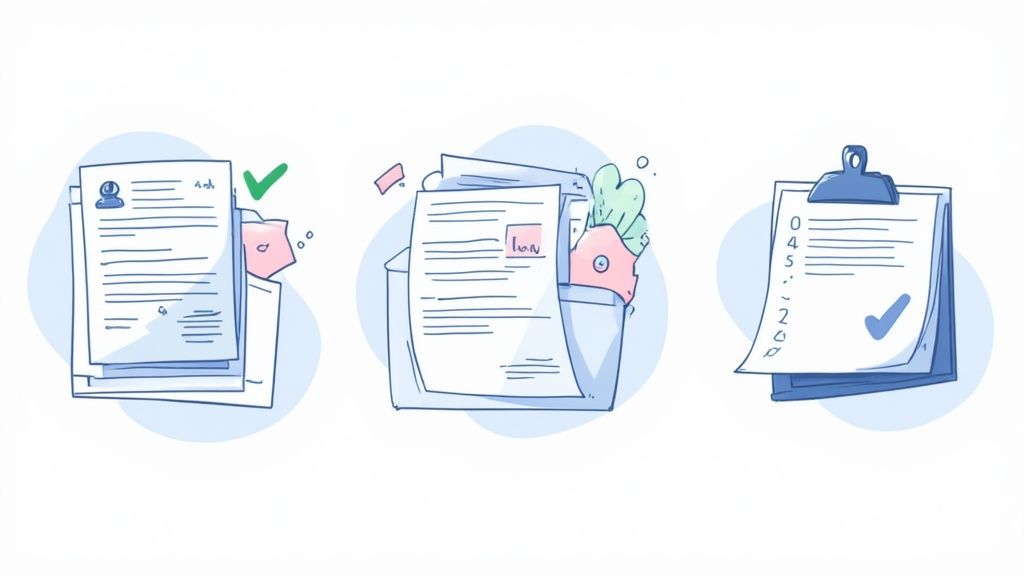
This journey from a chaotic pile of paperwork to an organised, automated workflow shows exactly what we're talking about. The final destination is a clean, auditable system where digital precision replaces manual effort—a change that modern tools put within reach for any company.
Automated Receipt and Invoice Processing
Manually entering receipts and invoices is easily one of the biggest time-wasters in any finance department. The old-school process involves printing, scanning, typing data by hand, and then filing everything away. It’s a workflow that practically invites typos, lost documents, and delays.
An automated system flips the script entirely.
- Before: Someone on your team spends hours every week keying in details from hundreds of receipts into a spreadsheet. A single slip-up, like swapping two digits in an invoice total, can derail the entire month-end reconciliation.
- After: With a tool like Mintline, receipts are just uploaded or forwarded from an email inbox. The system uses Optical Character Recognition (OCR) to instantly pull out key details like the vendor, date, and amount with machine-level accuracy. This gets rid of manual entry, slashes processing time by over 90%, and guarantees the data hitting your books is correct from the very beginning.
Flawless Bank Reconciliation
Bank reconciliation is a critical chore, but let's be honest—it's incredibly tedious. Manually matching every single line item from a bank statement to an invoice or receipt can take days, especially for businesses juggling thousands of transactions. It’s the perfect candidate for automation.
The difference between the old way and the new is night and day. Instead of a person staring at two documents and ticking off matches one by one, an automation platform gets it done in seconds. Mintline can connect to your live bank feeds or work with PDF statements, using AI to match each transaction to its corresponding document automatically.
Automating reconciliation isn't just about saving time. It's about achieving a level of accuracy that’s nearly impossible for a human to maintain. It turns a dreaded monthly task into a continuous, background process that gives you a real-time, accurate picture of your cash flow.
Streamlined Expense Reporting and Approvals
Expense reporting often creates friction between employees and the finance team. Employees hate chasing down receipts and filling out forms, while finance hates chasing employees for missing documents and enforcing company policy.
Process and automation can build a much smoother workflow for everyone involved.
- Submission: Employees just snap a photo of a receipt, and the data is pulled out automatically.
- Verification: The system can instantly flag expenses that fall outside company policy, like those over a spending limit or missing key details.
- Approval: Managers get a simple notification to approve the expense and can do so with a single click.
- Reimbursement: Once approved, the expense is automatically sent for payment and logged in your accounting software.
This organised flow eliminates guesswork, gets employees reimbursed faster, and gives the finance team total visibility over company spending as it happens. For a closer look at this area, you can learn more about automating accounts payable in our dedicated guide. And if you're looking to tackle the other side of the ledger, this guide to accounts receivable automation software is an excellent resource.
Your Practical Roadmap to Implementing Automation
Knowing what to automate is one thing; knowing how to start is another entirely. It's easy to feel overwhelmed by the possibilities, but the secret is to avoid trying to boil the ocean. A truly effective automation strategy starts with small, deliberate steps that deliver real results, fast.
This roadmap breaks that journey down into manageable stages. Think of it less as a massive, disruptive overhaul and more as building momentum with early wins and then scaling intelligently.
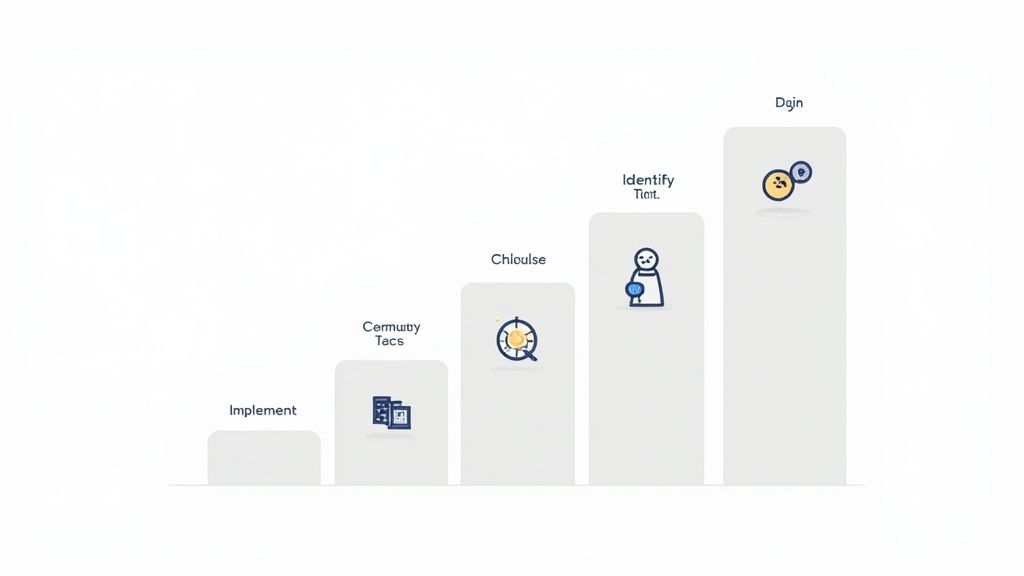
Stage 1: Identify Your Quick Wins
First things first: find the pain points. The best place to begin is with tasks that are high-volume, mind-numbingly repetitive, and strictly rule-based. These are your low-hanging fruit—the processes where automation can make the biggest difference with the least amount of heavy lifting.
What are those daily or weekly chores that eat up hours of your team’s time? Good candidates often look like this:
- Manually keying in data from stacks of receipts.
- Tediously matching bank statement lines to invoices.
- Constantly chasing employees for expense documents.
These tasks are perfect because they follow a predictable script, making them ideal for an automated system to take over.
Stage 2: Define What Success Looks Like
Before you change a single thing, you need a clear picture of the destination. What does a "win" actually look like for your team? Setting specific, measurable goals is non-negotiable—it's how you'll track progress and prove the whole effort was worthwhile.
Your goals can't be vague aspirations like "improve efficiency." They need to be concrete.
A strong goal sounds like this: "Reduce the time spent on monthly bank reconciliation from two full days to just two hours within the first quarter." That gives you a clear target and a deadline.
Define your key performance indicators (KPIs) upfront. Think in terms of processing time per invoice, error rates in data entry, or the percentage of transactions matched automatically.
Stage 3: Choose the Right Tools
With your goals set, it’s time to find the right technology. The market is flooded with generic automation platforms, but for finance, a specialised solution almost always comes out on top. Tools built specifically for finance departments, like Mintline, already understand the unique headaches of receipt matching and reconciliation.
When you're evaluating your options, keep these three things in mind:
- Ease of Use: Can your team get up and running without weeks of training?
- Integration: Does it play nicely with your existing accounting software?
- Specialisation: Is it actually designed for the specific financial documents and workflows you pinpointed back in stage one?
A purpose-built platform will come with features like advanced OCR for receipts and direct bank feed connections out of the box, saving you from a clunky, complicated setup. This is a critical step; the right tool makes everything that follows ten times smoother. To get a better handle on the tech that makes this possible, our article on intelligent document processing is a great place to start.
Stage 4: Implement and Test
Alright, it’s time to put the plan into action. A phased rollout is far safer than a "big bang" launch where everything changes overnight. Start with a single process or even a small part of your team. This creates a controlled sandbox where you can test the new workflow, get feedback, and work out any kinks before a company-wide deployment.
For instance, you could begin by automating receipt processing for just one department. This pilot programme lets you confirm the tool is doing its job and, just as importantly, helps you build a success story to show the rest of the organisation. This methodical approach builds confidence and makes the transition easier for everyone.
Stage 5: Monitor and Scale
Automation isn't a "set it and forget it" project. It’s a cycle of continuous improvement. Once your first automated workflow is up and running, keep a close eye on its performance against the KPIs you defined earlier. Are you hitting those time-saving goals? Has the error rate dropped like you expected?
Use these insights to fine-tune the process and look for your next opportunity. As you prove the value of that first project, you can start scaling your efforts, taking on more complex processes and bringing more of your financial operations into the automated fold. This iterative approach allows your automation strategy to grow and adapt right alongside your business.
So, Why Choose Mintline as Your Automation Partner?
Knowing you need to automate is one thing; finding the right tool for the job is a whole different challenge. You'll find plenty of general-purpose automation platforms out there, but they often come with a steep learning curve and don't really get the specific quirks of financial work.
That’s where Mintline is different. We built our platform from the ground up to solve the real-world financial headaches that small and growing businesses wrestle with every single day.
We're not trying to be a jack-of-all-trades. Our focus is laser-sharp: we master the most painful tasks for finance teams, like matching receipts and reconciling bank statements. This specialist approach means our technology is already tuned for the nuances of financial documents, so you get better accuracy and faster results right from the start.
Built for Finance, Not Just for Automation
Here’s the problem with generic tools: they can't tell the difference between a simple coffee receipt and a complex, multi-page invoice. This leads to constant errors and manual fixes, which completely defeats the purpose of automating in the first place. Mintline’s AI, on the other hand, has been trained on millions of financial documents. It understands the context, so it gets the job done right the first time.
This specialisation gives your business some very real advantages:
- Faster Implementation: You’re not starting from a blank slate. Our system comes pre-configured for financial tasks, so you can be up and running in minutes, not weeks.
- Greater Accuracy: Because our AI knows exactly what to look for on a receipt versus a bank statement, it cuts down matching errors dramatically.
- Intuitive Experience: We designed the entire interface for finance professionals, not IT gurus. Everything from the dashboard to the way you export data just feels logical and familiar.
From Messy Spreadsheets to Total Clarity
We created Mintline to solve the exact problems we’ve been talking about. It’s all about getting rid of manual data entry, locking in accuracy, and giving you a clear, real-time picture of your company's finances. We take hours of tedious admin work off your plate and turn it into a simple, hands-off process.
This screenshot shows our commitment to helping businesses organise their operations with a powerful and accessible solution.
The clean interface and focused messaging you see here get straight to the point: our goal is to bring order to financial chaos. This frees you up to focus on growing your business instead of getting buried in paperwork.
Mintline isn't just another piece of software; think of us as a dedicated partner for your financial operations. Our mission is to give you back your most valuable asset—time—while providing the financial clarity you need to make smarter, more confident decisions.
Security and Trust at Our Core
We know we’re handling your most sensitive financial data, and we take that responsibility very seriously. That’s why we’ve woven enterprise-grade security into every layer of our platform. All of your information is protected with AES-256 encryption, both when it's being sent and when it's stored.
We also store your data on secure, EU-based servers with AWS, which means we comply with strict data privacy regulations. And our policy is simple: we never share your information with third parties. With Mintline, you get a powerful automation engine built on a foundation of absolute trust and security. It’s the practical, reliable choice for your financial automation needs.
Common Questions About Process and Automation
When businesses first start looking into automation, the same questions tend to pop up. The thought of changing workflows you’ve used for years can seem intimidating, but getting started is usually much simpler and more rewarding than you might think. Let’s walk through some of the most common concerns to help clear the path.
These answers should help take the mystery out of the process and show how modern tools have put powerful automation within everyone's reach.
How Long Does Implementation Actually Take?
This is usually the first question on everyone's mind, often accompanied by visions of a long, drawn-out IT project. The good news? Those year-long overhauls are largely a thing of the past. With a focused, finance-specific platform like Mintline, you can get your core financial processes automated in a matter of days or weeks, not months.
The trick is to avoid boiling the ocean. Don't try to automate everything at once. Pick a single, high-impact workflow—like receipt matching or bank reconciliation—and start there. Nailing that one process gives you a quick win, proves the value right away, and builds momentum for what comes next. This approach turns one massive project into a series of small, manageable steps.
Is Automation Only for Large Companies?
Absolutely not. This is probably one of the biggest myths about automation, and it’s completely out of date. Maybe a decade ago, you needed a huge budget and a dedicated IT department to even consider it, but the game has totally changed.
Cloud-based tools and flexible subscription models have completely levelled the playing field. Now, platforms like Mintline make powerful automation affordable for businesses of all sizes, from freelancers and startups to established small and medium-sized businesses. You only pay for what you need and can scale up as you grow, so the solution always fits your budget.
Modern automation is all about accessibility. It's no longer about the size of your company but the smartness of your operations. Small, agile businesses can now use the same efficiency tools that were once reserved for the big players.
Will Automation Replace My Finance Team?
This question comes from a very real place, but the answer is a firm no. Automation doesn't replace skilled professionals; it elevates them. Think of it as giving your team a major toolkit upgrade, not making them redundant.
Automation is brilliant at handling the repetitive, error-prone tasks that no finance expert actually enjoys doing. It takes care of all the manual data entry, the tedious matching, and the administrative grind.
This frees up your finance team to focus on what people do best: strategic analysis, financial forecasting, advising the business, and solving complex problems. By taking the boring stuff off their plate, you unlock their true potential and let them add real value where their expertise actually matters.
Ready to see how Mintline can solve your financial automation challenges and turn hours of manual work into minutes? Take control of your finances and get started today at https://mintline.ai.