
Receivables and Payables: Master Your Cash Flow with Mintline
Discover how receivables and payables affect cash flow, track key metrics, and automate processes to boost your Dutch business.
Let’s get right to it. Think of receivables and payables as the two sides of your business's financial heartbeat. In simple terms, receivables are the invoices you’ve sent out for your work—it’s the money you're owed. Payables are the flip side: the bills from your suppliers that you need to pay.
Feeling Your Financial Pulse
For any Dutch freelancer, startup, or small business, getting a firm grip on receivables and payables is more than just good bookkeeping; it’s fundamental to staying afloat. These two accounts track the cash moving in and out of your company, directly impacting your ability to pay your team, cover your costs, and plan for the future.
Let's make it concrete. Imagine you run a creative agency in Amsterdam. When you hire a freelance photographer for a project and agree to pay them in 30 days, you’ve just created an accounts payable—a debt you need to settle.
On the other hand, when you complete that project and send your client an invoice, you’ve created an accounts receivable—money that is rightfully yours, but hasn't hit your bank account yet.
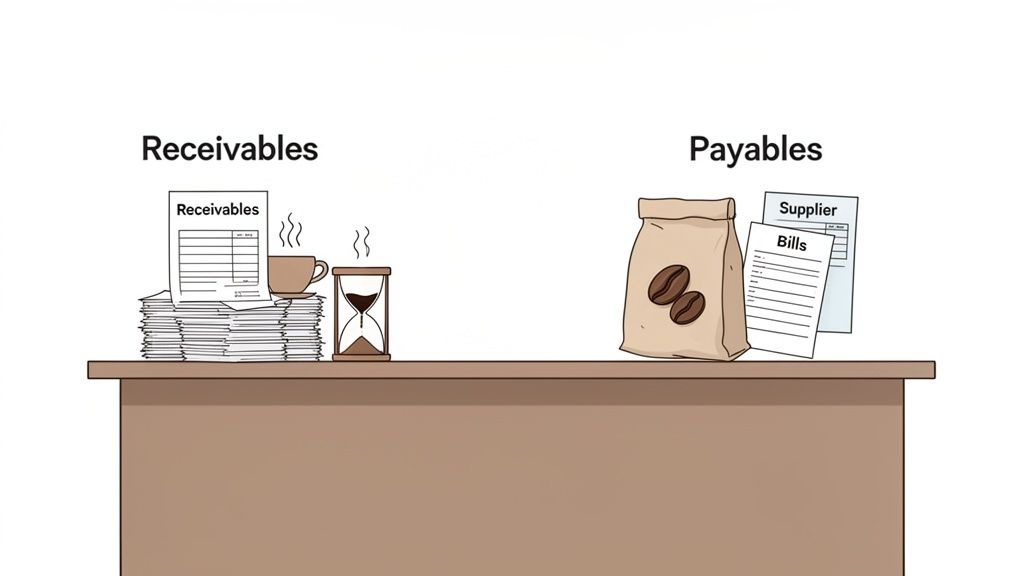
Two Sides of the Same Coin
These two elements are woven together, driving your entire cash flow cycle.
-
Accounts Receivable (AR): This is all the money your customers owe you. On your balance sheet, AR is listed as a current asset because it’s cash you expect to receive soon. Getting this money in the door efficiently is absolutely vital.
-
Accounts Payable (AP): This represents the money you owe to suppliers, vendors, or contractors. It shows up as a current liability on your balance sheet, signalling a short-term obligation you need to fulfil.
The real art of financial management lies in balancing the timing of these two flows. You have to collect your receivables fast enough to cover your own payables. If there’s a mismatch, you’ll hit a cash flow gap—a stressful situation where your bills are due before your clients have paid you.
This balancing act is a huge deal here in the Netherlands. In fact, the country's financial sector liabilities tied up in receivables and payables recently hit 17.70% of GDP. This figure, which you can explore further on the Dutch financial landscape on Trading Economics, shows just how reliant our economy is on credit-based transactions.
For business owners, this creates a massive administrative headache. Keeping track of which payment belongs to which invoice is a constant chore, and this is exactly where accurate document matching becomes essential. It’s why so many are turning to platforms like Mintline, which automatically links bank transactions to the right receipts and invoices, delivering the clarity needed to manage cash flow effectively.
To make the distinction crystal clear, let's break it down side-by-side.
Receivables vs Payables At a Glance
| Aspect | Accounts Receivable (AR) | Accounts Payable (AP) |
|---|---|---|
| What It Is | Money owed to your business by customers. | Money your business owes to suppliers or vendors. |
| On the Balance Sheet | Recorded as a Current Asset. | Recorded as a Current Liability. |
| Represents | Future cash inflow. | Future cash outflow. |
| The Goal | Collect payment as quickly as possible. | Pay on time, but not too early, to manage cash flow. |
| Common Documents | Sales invoices, customer statements. | Purchase orders, supplier invoices, credit memos. |
| Impact on Cash Flow | Increases cash flow when collected. | Decreases cash flow when paid. |
This table gives you a quick snapshot, but the key takeaway is that managing both AR and AP effectively is what keeps your business financially healthy and ready for growth.
Why Managing Cash Flow Is Your Most Important Job
Let's be blunt: profit on paper means nothing if you can't pay your bills. This is the simple, sometimes harsh, reality of cash flow, and at its heart are two moving parts: your receivables and payables. When these fall out of sync, you hit what’s known as the 'cash flow gap'—and it’s a real headache.
This gap is that all-too-familiar, stressful window of time when your own bills are due before your customers have paid you. It’s a recurring nightmare for businesses of every shape and size, from freelancers juggling invoices to small companies trying to grow.
Think of a bustling creative agency in Rotterdam. They've just wrapped up a huge project, and the profit margin looks fantastic. The problem? Their client is on a 60-day payment term, but the agency’s payroll and rent are due at the end of the month. That right there is the cash flow gap in action. It’s a situation that can easily choke an otherwise healthy business.
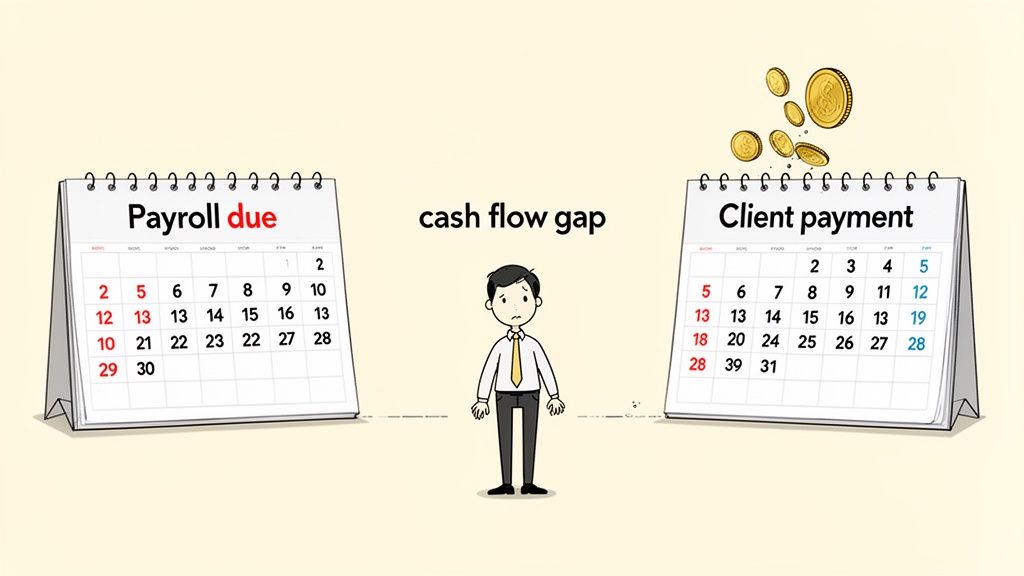
The Two Sides of the Cash Flow Coin
When you break it down, the problem comes from two directions.
On one side, slow-paying customers (delayed receivables) are a direct threat to your stability. Having to wait for money you’ve already earned puts a massive strain on your finances, forcing you to make tough choices you shouldn't have to.
On the other side, a messy payables system creates its own chaos:
- Late Fees: If you can’t keep track of what’s due when, it’s far too easy to miss a deadline and get hit with penalties.
- Strained Relationships: Paying suppliers late is a quick way to damage trust and earn a bad reputation.
- Missed Opportunities: Many suppliers offer discounts for early payment. You can only grab those savings if your payables process is sharp enough. You can learn more about fine-tuning this in our guide to the automated processing of invoices.
In the Netherlands, this challenge is amplified by just how much money moves around. The country's balance of payments financial account can swing wildly, from a record high of €11,241.60 million to a low of €909.60 million in the same year. These huge shifts, which you can see in the Dutch financial account data on Trading Economics, show just how quickly the broader economic tide can turn.
For Dutch businesses, this economic volatility makes forecasting cash flow incredibly difficult without real-time, accurate data. You simply cannot afford to guess which invoices are paid and which are still outstanding.
Ultimately, your accounts receivable and payable aren't just numbers on a balance sheet. They are the levers you pull to control your company’s day-to-day financial health and its long-term survival. That’s why a platform like Mintline, which takes the painful, manual task of matching transactions to documents off your plate, is so crucial—it delivers the clarity you need to keep your cash flowing.
The Metrics That Actually Matter for Financial Health
You can't fix what you don't measure. When it comes to managing receivables and payables, gut feelings won't cut it—you need hard data. Tracking the right metrics is like having a financial health monitor for your business, giving you a clear, honest picture of where you stand.
These numbers aren't just accounting jargon; they're practical tools telling a story. They show you how efficiently you're using cash, managing credit, and nurturing relationships with both customers and suppliers. For any Dutch business, getting to grips with these metrics is the first step toward making smarter financial decisions.
Measuring Your Inflow: Days Sales Outstanding
One of the most important numbers for your receivables is Days Sales Outstanding (DSO). Put simply, DSO tells you the average number of days it takes for your customers to pay you after you've made a sale.
A high DSO isn't just a figure on a spreadsheet; it's a red flag. It means it's taking too long to get the money you've earned, which can put a massive squeeze on your cash flow. A DSO of 60, for example, means your cash is tied up for two whole months after you've already delivered your product or service.
A consistently high DSO often points to deeper problems in your collections process. Maybe your payment terms are confusing, your follow-up is patchy, or you're extending credit to customers who are notoriously slow payers.
Gauging Your Outflow: Days Payables Outstanding
On the flip side, you have Days Payables Outstanding (DPO). This metric tracks the average number of days it takes your company to pay its suppliers. It's a great indicator of how well you're managing the credit they've extended to you.
A very low DPO might seem responsible—and it can be—but it could also mean you're paying your bills too early. You might be missing a chance to use that cash for other things, like investing in growth. On the other hand, a sky-high DPO can damage your reputation, strain supplier relationships, and land you with late payment fees.
The sweet spot is finding a balance. You want to hold onto your cash for a reasonable amount of time to optimise your working capital, but without ever being late.
Here’s a quick breakdown of these key metrics and what they reveal about the health of your business.
Essential AR and AP Performance Metrics
| Metric | What It Measures | Simple Formula | What to Aim For |
|---|---|---|---|
| Days Sales Outstanding (DSO) | The average number of days it takes to collect payment after a sale. | (Accounts Receivable / Total Credit Sales) x Number of Days | A lower number is generally better, indicating faster cash collection. |
| Days Payables Outstanding (DPO) | The average number of days it takes your company to pay its suppliers. | (Accounts Payable / Cost of Goods Sold) x Number of Days | A moderate to high number, without being late, shows good cash management. |
At the end of the day, mastering these receivables and payables metrics puts you in the driver's seat. It lets you spot potential problems early, tweak your strategies on the fly, and build a much more resilient financial foundation for your business.
The Financial Admin Headaches We All Know Too Well
We’ve all been there. Staring at a mountain of invoices, bank statements, and receipts, wondering where the day went. For founders and freelancers, this financial grind isn't just a chore; it's often the most soul-crushing part of running a business.
It’s the late nights spent manually matching payments, the low-grade panic that a single typo has thrown off your entire month's books, and the awkward dance of chasing clients for money they owe you. This isn't just a minor annoyance—it's a massive drag on your time, energy, and focus.
These problems are universal, but in the Netherlands' dynamic economy, the sheer volume of transactions can turn a small headache into a full-blown migraine.
The Problem with Doing it all by Hand
Picture a small e-commerce shop based in Utrecht. Every month, they're hit with hundreds of supplier invoices while trying to track customer payments coming in from multiple platforms. Manually trying to connect all those dots is a fast track to burnout.
- It’s a Time Vampire: A task you think will take ten minutes ends up consuming your entire afternoon as you painstakingly cross-reference spreadsheets and bank statements.
- Mistakes are Inevitable: One misplaced decimal point or a simple data entry slip can create a financial mess that takes hours to untangle.
- You're Flying Blind: Without a clear, real-time picture of your cash flow, how can you possibly make smart decisions about what to invest in next?
Simply put, the old manual way is broken. It stifles productivity and stops business owners from doing what they actually love: growing their company and looking after their customers.
The scale of this challenge is immense. The Netherlands is a hub of constant commercial activity, which means businesses are processing a relentless stream of transactions. In this high-speed environment, manual document matching isn’t just inefficient; it's completely unsustainable.
The national economic data tells a similar story. The Netherlands regularly processes huge sums in goods expenditure as part of its balance of payments, with recent quarterly figures around €142.76 billion. For any Dutch business, especially in the trade sector, matching every transaction to its paperwork is absolutely vital. When you're dealing with numbers that big, even a tiny error in your receivables and payables matching can blow a serious hole in your finances. You can dig into the specifics in the Dutch economic activity data on FRED.
Once we face these common frustrations head-on, it becomes obvious why so many businesses are looking for a better way. The real goal is to find a solution like Mintline that gets rid of the administrative grind for good, freeing up founders to reclaim their most precious resource: time.
Actionable Steps to Streamline Your Financial Workflow
Moving from chaos to control over your receivables and payables isn't about a massive, overnight overhaul. It's about building smarter habits into your daily routine. A few practical adjustments can make your financial operations more efficient, predictable, and frankly, a lot less stressful. Let's turn theory into action.
Getting Paid Faster
Optimising your accounts receivable is all about one thing: making it incredibly easy for your clients to pay you on time. The faster that cash comes in, the healthier your business becomes. Start with these proven tactics.
-
Set Crystal-Clear Payment Terms: Don't leave any room for interpretation. Clearly state your payment terms—like "Net 15" or "Due upon receipt"—on every single invoice. This sets expectations right from the start.
-
Send Automated Reminders: Manually chasing late payments is a massive time sink. Use accounting software or a platform like Mintline to send polite, automated reminders for upcoming and overdue invoices. It takes the awkwardness out of the follow-up and gets the job done.
-
Offer Multiple Payment Options: Make it convenient to pay you. By accepting bank transfers, credit cards, and online payment gateways, you remove friction and give clients no excuse for delays.
Managing What You Owe
Good accounts payable management isn't about dodging bills; it's about paying them strategically to maximise your cash flow and keep your suppliers happy. This is how you build a reliable operational foundation. For a deeper dive, this guide to efficient remote accounts payable workflows has some great insights.
Bringing order to your payables provides immediate clarity and control.
-
Organise Invoices Immediately: Don't let supplier invoices pile up in your inbox or on your desk. A platform that digitises and organises them automatically the moment they arrive is ideal. This simple habit prevents bills from getting lost and gives you a clear picture of your upcoming financial commitments. For more on this, check out our guide on how to automate your accounts payable process.
-
Schedule Payments Strategically: Instead of paying bills the second they land, schedule them based on their due dates. This simple move allows you to hold onto your cash longer, improving your working capital without ever risking a late fee.
-
Communicate with Suppliers: Strong relationships are built on clear communication. If you see a payment delay on the horizon, let your supplier know in advance. A little honesty goes a long way in maintaining trust and goodwill.
Adopting these small but powerful habits for both your receivables and payables puts you back in the driver's seat. It transforms financial management from a reactive, stressful chore into a proactive, strategic part of your business growth.
How Automation Ends Document Matching for Good
Let's be honest: the manual process of matching receipts to transactions is broken. It's a soul-crushing, error-prone task that creates a huge bottleneck for any growing business. It forces founders and finance teams to spend countless hours drowning in spreadsheets and digging through folders of PDFs.
There is a much, much better way to manage your receivables and payables.
Mintline’s AI-powered platform turns this dreaded administrative chore into a simple, automated workflow. Forget about spending hours manually cross-referencing documents. You just connect your bank account, and our technology gets to work. It automatically reads your bank statements, pulls out the key transaction data, and instantly matches it to the right receipts and invoices you’ve uploaded.
This isn’t just about saving time. It’s about bringing a whole new level of accuracy and clarity to your financial workflow.
From Manual Grind to Simple Review
At its core, Mintline changes your role from a data entry clerk to a strategic reviewer. Instead of doing the tedious matching yourself, you’re presented with a clean, easy-to-use review screen where the AI has already done all the heavy lifting. When you find ways to automate accounts payable, you can put an end to manual document matching and get your financial operations running smoothly.
This is what an ideal workflow should look like: clear, manageable steps for organising, scheduling, and paying.
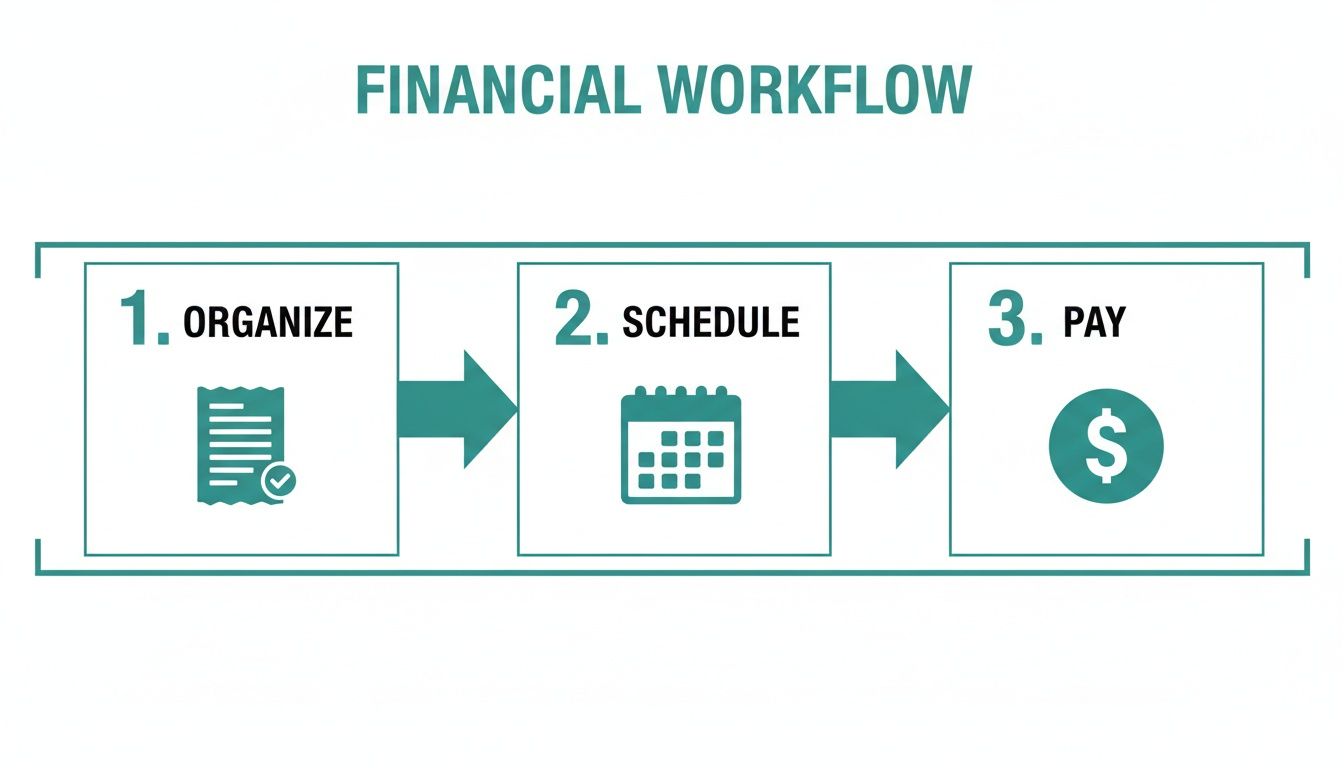
Automation helps you get there by taking care of the most labour-intensive parts, leaving you free to focus on the high-level decisions that actually matter.
Real-Time Visibility and Control
With a real-time dashboard, you can see your progress at a glance. You’ll always know exactly which documents have been matched, which are still missing, and which ones are just waiting for your final approval. This kind of visibility is absolutely essential for keeping a firm grip on your company's financial health.
Mintline replaces hours of painful administrative work with just a few minutes of simple review. This frees you up to focus on what truly matters—running and growing your business.
The system's clarity means you can quickly spot and sort out any outstanding items, making sure your books are always accurate and up-to-date. And when it’s time for taxes or an audit? Exporting clean, audit-ready records is as simple as a single click.
If you're curious about the technology that makes this possible, you can dive deeper in our guide to https://mintline.ai/blog/intelligent-document-processing.
Common Questions Answered
Let's tackle some of the most common questions that pop up when you're trying to get a handle on your business's finances. Think of this as your quick-start guide to moving from financial theory to real-world action.
Where Do I Even Start with Improving My Receivables?
The very first step is to be crystal clear about your expectations. Make sure every single invoice you send has explicit payment terms, like ‘Net 15’ or ‘Net 30’. This sets a professional tone from the get-go.
Once that's done, create a simple, consistent process for following up on late payments. It doesn't have to be complicated—a friendly email reminder a day or two after the due date can work wonders. Better yet, let a platform like Mintline handle automated reminders for you.
How Can I Manage Payables Better Without Annoying My Suppliers?
It all comes down to two things: organisation and communication.
As soon as a supplier invoice hits your inbox, use a tool to log it automatically. Don't let it get buried. This simple habit prevents things from slipping through the cracks. Then, you can plan your payments around your cash flow, ensuring you always pay on time. If a payment is going to be a few days late for some reason, a quick, proactive email to your supplier builds a massive amount of goodwill.
Is It Worth It for a Small Business to Pay for Bookkeeping Automation?
Absolutely. The old myth that automation is only for big corporations is long gone. Modern tools like Mintline are built specifically for freelancers and small businesses, making them incredibly affordable.
Think of it this way: automated bookkeeping isn't just an expense. It's an investment in your own time. The hours you win back from tedious data entry are hours you can pour directly into serving clients and growing your business.
The return on investment is usually very quick, especially when you factor in the cost of a single missed invoice or a late payment fee.
How Exactly Does Automated Document Matching Help if I Get Audited?
Automation is an auditor's best friend. It creates a perfect, easy-to-follow digital trail for every penny that moves in and out of your business.
With Mintline, each bank transaction is automatically linked to its corresponding invoice or receipt. So, if an auditor asks for proof of a specific expense from six months ago, you’re not digging through a shoebox. You’re just clicking a button and exporting a report. It turns a potentially week-long headache into a five-minute task.
Ready to stop chasing receipts and get your time back? Mintline uses AI to automatically match every bank transaction to its corresponding document, giving you perfectly organised books in minutes. Learn more and try Mintline for free at https://mintline.ai.